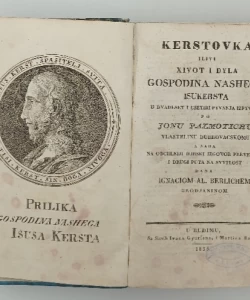
Kristiada
Basic information
- Author: Palmotić Junije
- Publisher: -
- Availability: Available
- Condition: Very good
- Code: 19594
Shipping options
Payment methods
Explore more
Kristiada
Palmotić Junije
Summary
Junije Palmotić: Kristiada
With a dictionary of unknown words at the end of the book.
From the preface:
Here, at the expense of Matica, another work of ancient Dubrovnik literature is brought to light. This song was sung and written two hundred years ago based on the Latin work of Jerolim Vida, which was titled "Christiade" in 1535. sang the life and deeds of Jesus in hexameters, dividing his song into six cantos. This Latin work was only for Palmotić, that his spirit in its free poetic flight had something to hold on to, and from that Vidin's six cantos on his Slovenian lyre multiplied to twelve and four and grew to 4321 stanzas.
However, his work was not printed alive for him. The same, after his death and the fall of Dubrovnik in the year 1667, was published by his brother Juraj in Rome in the printing house of Jakob Maskardić in 1670. This edition is probably based on the original manuscript of Gjon himself, and since there were no other manuscripts, it was decided that this edition should be kept entirely according to the way the first edition of Christiad was published in Rome. I will quote a few stanzas from various chants ... It is obvious to every reader that we adopted an organic spelling in the reprint of Christiade, which, when our language is written in Latin letters, is everywhere known and common. This had to be done so that the edition of this magnificent work by Palmotić could achieve its purpose and be widely read and disseminated.
From the Internet:
Junije Palmotić (1607-1657) is a Croatian baroque poet and dramatist, originally from a noble family. He held numerous positions in the administration of the city of Dubrovnik (he was also a member of the Grand Council). He translated the famous epic Christias by the Italian writer Girolamo Vida, calling it Cristiada. According to his wishes, the epic will be published in the Eternal City, with an exhaustive accompanying letter from Stjepan Gradić, the great Dubrovnik diplomat and curator of the Vatican Library. In accordance with the literary customs of his time, Palmotić also uses the stories of ancient mythology in order to clothe them with current messages intended for contemporaries. He writes melodramas in which the mythological world alternates with the knightly one, having in front of him templates in episodes from Ovid, Virgil, Tasso and Ariosto, which he also reworks; some he skilfully localized and placed in our premises, and others he gave the taste of Dubrovnik legend, while giving vent to his patriotism.
A very well-preserved specimen!
Additional information
- Author: Palmotić Junije
- Publisher: -
- Year of publication:1852
- Place of publication:Zagreb
- Pages:232
- Dimensions:15x23.5 cm
- Script:Latin script
- Condition:Very good
- Binding:Hardcover
Reviews
0 reviewsWrite a review
Share your experience and help other readers choose.
This item has no reviews yet. Be the first to share your experience.
More books by Palmotić Junije
You may also like






Recently viewed