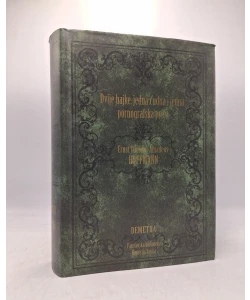
Palim Pariz
Basic information
- Author: Jasienski Bruno
- Publisher: Šareni dućan
- Availability: Available
- Condition: Excellent
- Code: 56305
Shipping options
Payment methods
Explore more
Palim Pariz
Jasienski Bruno
Summary
Bruno Jasienski: Fallen Paris
The literary work of Bruno Jasieński (1901-1938), one of the most significant representatives of Polish avant-garde literature, as well as his life path, from his youthful obsession with futurism, through the Parisian per asper ad astra, to the harsh socialist realist reality of Stalinist Russia, still cause many contradictions to this day. Persecuted by the police because of his political beliefs and disappointed by the reception of his futuristic-avant-garde songs and stories, Bruno Jasieński went to Paris in 1925, where he lived in poverty and on the verge of starvation for four years. He associated himself with the French communists, he wrote in various newspapers, and in 1929 he was expelled from France for his most famous work: Fallen Paris.
This catastrophic-fantasy novel about the downfall of a large "bourgeois" city caused a real storm in the French capital immediately after its release. Attacks on the author came from all sides, which was an additional advertisement for the book, so the first print run of 140,000 copies was looted, and a second edition of 220,000 copies soon followed... but the French were already fed up with a foreigner who spits on their honor and reputation, and they revoked his residence permit. To the persecution from France, the Soviet authorities responded with a welcome and Jasieński was welcomed in Moscow with numerous honors, as a hero. And then follows an apparently confusing twist, but also, we would say, a story typical of the era of Stalinism: Jasieński starts writing in Russian and gradually becomes a socialist realist writer and one of the main propagators of the regime, only to end up as a victim of it.
Additional information
- Author: Jasienski Bruno
- Publisher: Šareni dućan
- Year of publication:2015
- Place of publication:Koprivnica
- Pages:310
- Dimensions:14x21 cm
- Script:Latin script
- Condition:Excellent
- Binding:Hardcover
Reviews
0 reviewsWrite a review
Share your experience and help other readers choose.
This item has no reviews yet. Be the first to share your experience.
More books from Šareni dućan







You may also like