Tarahumare i druga djela
Basic information
- Author: Artaud Antonin
- Publisher: Litteris
- Availability: Available
- Condition: New book
- Code: 31080
Shipping options
Payment methods
Explore more
Tarahumare i druga djela
Artaud Antonin
Summary
Antonin Artaud: Tarahumara and other works
"When they go down to the towns, the Tarahumara beg. (...) If they get, they don't say thank you. Because giving to someone who has nothing is not even an obligation for them, it is the law of physical reciprocity that the White World has betrayed. (.. .)This law of physical reciprocity that we call alms, the Indians apply naturally, and without any pity. (...) When ate, the beggar leaves without thanking or looking at anyone," wrote Antonin Artaud, one of the greatest writers of the 20th century, in Mexico in 1936. Just one year later, in 1937, in France, he was imprisoned in an insane asylum. If he had been "better situated", he probably would have at least been spared this, he, whose collected works today comprise 26 books, he, who shot twenty film roles, wrote seven screenplays, in the theater was an actor and scenographer and director and costume designer and playwright and choreographer and theater theoretician (seven professions in total), drew enough drawings to make an exhibition... Artaud's texts collected in this book are certainly among the most resonant in the whole his oeuvre.
Van Gogh, the Murdered Suicide was written like a kind of testament, a final reckoning with the world, in the last year and a half that Artaud lived after his release: "(...) Van Gogh was never afraid to fight in order to live, that is, to deny the idea of existence to the fact of life, and of course everything can exist without trying to be, and everything can be without trying to shine and shine, like the frantic Van Gogh. (...) What Van Gogh cared about most in the world was his painterly idea, a fanatical, apocalyptic, visionary idea. That the world should be arranged according to his own matrix, its accelerated rhythm contrary to spiritual life, the rhythm of an occult festival, and in the town square, returned to overheating in the melting pot."
Additional information
- Author: Artaud Antonin
- Publisher: Litteris
- Year of publication:2003
- Place of publication:Zagreb
- Pages:307
- Dimensions:13x20.5 cm
- Script:Latin script
- Condition:New book
- Binding:Softcover
Reviews
0 reviewsWrite a review
Share your experience and help other readers choose.
This item has no reviews yet. Be the first to share your experience.
More books by Artaud Antonin
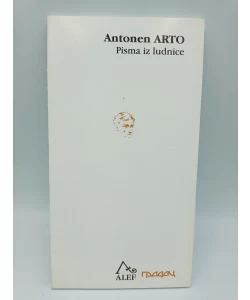
More books from Litteris






You may also like





Recently viewed