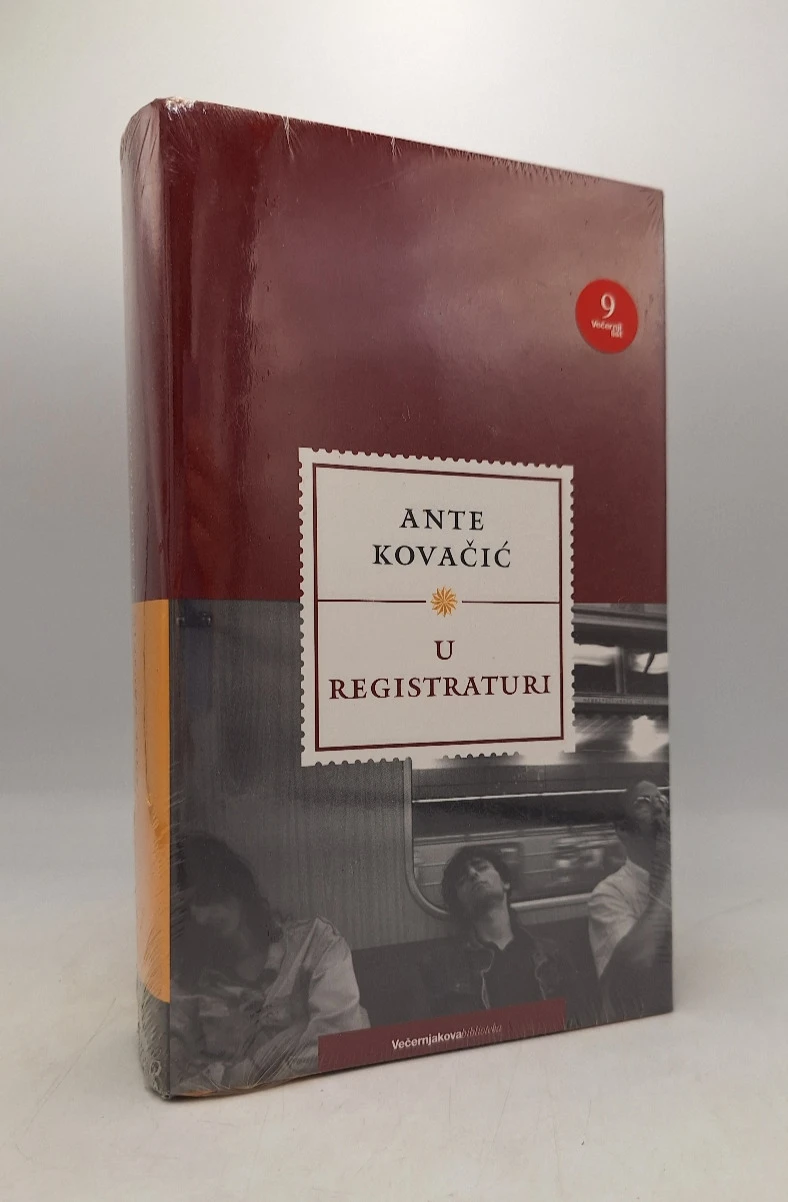

Kovačić Ante: U registraturi
€ 6,00
Free delivery in Croatia for orders over EUR 70
Basic information
- Author: Kovačić Ante
- Publisher: Večernji list
- Availability: Available
- Condition: Nova knjiga
- Code: 26939
Shipping options
GLS Croatia
5€
Delivery
0€
Personal collection at the antique store
0€
GLS parcel machine
3€
Payment methods
Pay on pickup
CorvusPay
By general payment / Virman / Internet banking
Cash on delivery
U registraturi
Kovačić Ante
Summary
Ante Kovačić: In the registry
The title tells us that the story begins in the registry, where the main character Ivica Kičmanović worked as a registry. The registry office itself becomes a symbol of the current state of affairs in Croatia. Genre-wise, the novel can be said to be social, but also a novel about upbringing. It is a social novel because it tells us about the stratification of Croatian society, and a novel about upbringing because it tells about the son of a peasant Jožica Kičmanović - Zgubidan, who goes to the city for schooling.
Elements of both realism and romanticism run through all of Kovačić's works.
The novel U registraturi not only talks about social conditions in Croatia, but also about the economic and social changes that took place in the country in the second half of the 19th century (agrarian the crisis of 1873, class struggles, the decline of the aristocracy, the stratification of the countryside). The author faithfully portrays the picture of the birth of "modern" Croatia and the development of intelligence in society, as well as the chronology of the tragic life of the peasants in capitalist and feudal relations, which are manifested in the relationship of the lords (feudal lords) towards the peasant and his way of life.
In the work, Kovačić writes about the morality and psychology of the Croatian city and countryside, the phenomena that occur in them, for example - the mutual relations of the peasants, the relationship between parents and children (Ivica and Ivica's mother), quarrels and friendships, quarrels, love relationships in the city (Ivica and Laura, Mecena and Laura, Ferkonja and Laura) and love relationships in the countryside (Anica and Ivica, Miha and Justa, Medonić's servant and Medonić's wife). We can notice that Kovačić still showed more love and sympathy for the setting in the village and describes the village as such in more detail (patriarchal life, village customs, peasant morals), but he did not idealize it. He sees the village as an expression of unenlightenment, superstition and primitivism, while the city differs from the countryside in terms of morality and way of life. The peasant does not know his way around the city and behaves clumsily and strangely (when Ivica greets strangers and passers-by on the street in the city).
The novel is, in a way, also an autobiography of the author, which he shows not only in the character of Ivica Kičmanović, but also in the spiritual life and fate of other characters who appear in the work, such as, for example, Laura, and divides it into three (3) parts. The events are not arranged and organized according to time, because the author breaks the temporal continuity by inserting retrospective episodes, which brings drama and a certain "restlessness" to the work. The very beginning of the work is retrospective because it shows the writings and registries that Ante Kovačić brings to life and announces the plot, the backbone of which is the events narrated by Ivica Kičmanović (the main character) in the first part of the novel, while in the second and third parts, the narration is taken over by the writer.
Additional information
- Author: Kovačić Ante
- Publisher: Večernji list
- Year of publication:2004
- Place of publication:Zagreb
- Pages:455
- Dimensions:13x21 cm
- Script:Latinica
- Condition:Nova knjiga
- Binding:Tvrdi s ovitkom
You may also like






Recently viewed
Biblos Newsletter
For book lovers who enjoy finding the rare
New titles, special copies and quiet recommendations from the antiquarian bookshop.