
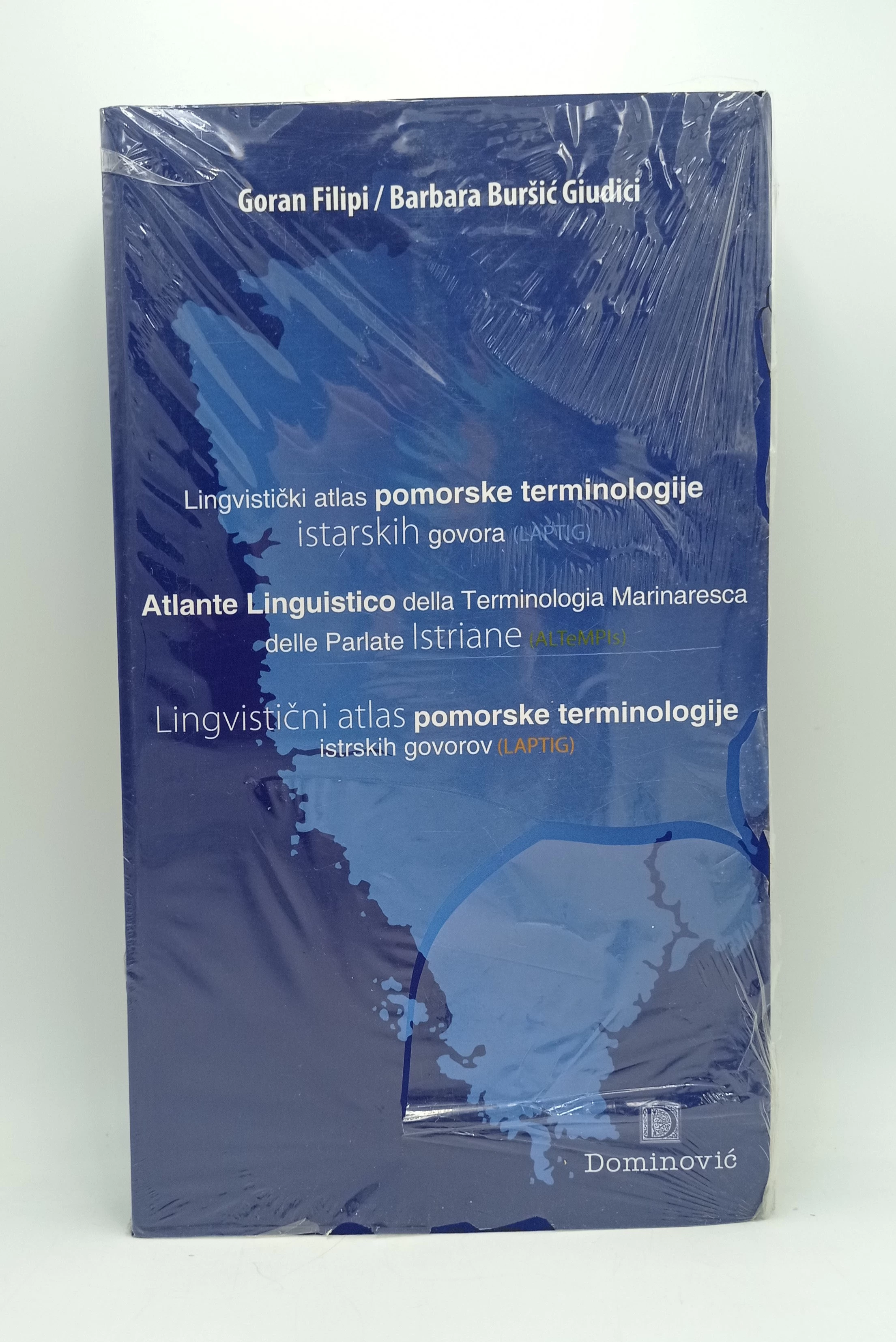
Lingvistički atlas pomorske terminologije
Basic information
- Author: Buršić Giudici Barbara | Filipi Goran
- Publisher: Dominović
- Availability: Available
- Condition: New book
- Code: 38251
Shipping options
Payment methods
Explore more
Lingvistički atlas pomorske terminologije
Buršić Giudici Barbara | Filipi Goran
Summary
Linguistic atlas of maritime terminology
Trilingual edition: Croatian, Italian, Slovenian
Pok. professor Pavao Tekavčić was one of the best connoisseurs of the language situation and language relations in Istria, and in the 1970s he proposed the creation of a language atlas of Istria, but this idea was not realized. On that trail, prof. In the early 1990s, Dr. Goran Filipi began to realize this idea within the Atlas Linguarum Histriae et Liburniae project, and it is still being worked on today. After several years of systematic collection of material in individual places, in 1998 the authors of LAPTIG published the Istrian Linguistic Atlas (ImLA), an important work that contributes to the preservation of the linguistic and cultural heritage of Istria, and at the same time a valuable source for the study of various aspects of language contacts. The same authors are currently completing the large volume Linguistic Atlas of Istrian Chakavian Speeches (LAIČaG). Such demanding projects, which are extremely important for language studies, are carried out in the scientific world by well-equipped institutes with numerous collaborators (compilers of questionnaires, field interviewers, videographers, etc.), and here this complex job is acad. Filipi performed mainly with his longtime colleague Dr. Barbara Buršić Giudici and students. In this atlas, elements of the traditional material civilization and spiritual culture of Istrian life, as well as the history of relations between different groups, have been collected and written down. Linguistic geography has long warned that in the development of language, in addition to internal genetic dynamics, there is also the so-called contact dynamics: although each idiom is primarily the result of its own internal development, there is no human idiom that, under appropriate circumstances, did not take over units and structures from those idioms with which it was in contact. All of these can be read from the atlas in front of us.
Additional information
- Author: Buršić Giudici Barbara | Filip...
- Publisher: Dominović
- Year of publication:2013
- Place of publication:Zagreb
- Pages:415
- Dimensions:17x29.5 cm
- Script:Latin script
- Condition:New book
- Binding:Softcover
Reviews
0 reviewsWrite a review
Share your experience and help other readers choose.
This item has no reviews yet. Be the first to share your experience.
More books by Buršić Giudici Barbara | Filipi Goran
More books from Dominović

You may also like







Recently viewed