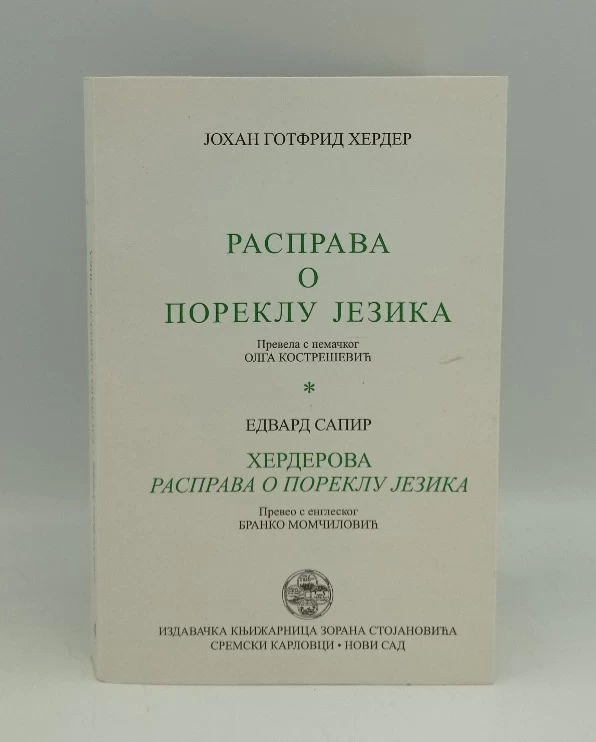
Rasprava o poreklu jezika, Herderova rasprava o poreklu jezika
Basic information
- Author: Herder Johan Gottfried
- Publisher: Izdavačka knjižarnica Zorana Stojanovića
- Availability: Available
- Condition: Very good
- Code: 45796
Shipping options
Payment methods
Explore more
Rasprava o poreklu jezika, Herderova rasprava o poreklu jezika
Herder Johan Gottfried
Summary
Johan Gottfried Herder: A treatise on the origin of language, Herder's treatise on the origin of language
In 1769, the Berlin Academy published the following as the subject of a prize competition, as was the custom, in French: »En supposant les hommes abandonnées à leurs facultés naturelles, sont‒ils en état d'inventer le langage? Et par quels moyens parviendront‒ils d'eux‒mêmes à cette invention?” There are two things in the style of this theme that are characteristic of that era. First, it will be noted that the main point of this discussion should have been: is language of natural, i.e. human, or supernatural origin. It could not then be taken for granted, as normal researchers would do today, that man had acquired the gift of speech in an entirely natural way; the burden of proof was, in fact, on those who disputed the divine origin of language. And secondly, the question of the Academy talks about language as an "invention". Just as a machine is a "tool", a means to achieve some other mechanical effects, so language was seen as a tool, a means to achieve some other desired mechanical effects, namely, the transmission of ideas by means of audible and then visible symbols. And since history and experience have shown, or seemed to show, that machines were "invented" by the application of certain powers of intelligence, the logical parallel seemed to demand that this wonderful invention called language also represents the "invention" of some kind of intelligence. Then the only question was this: was the human mind intelligent and resourceful enough to invent such a fine machine, or did it require a divine hand? Voilà tout.
Additional information
- Author: Herder Johan Gottfried
- Publisher: Izdavačka knjižarnica Zorana S...
- Year of publication:2012
- Place of publication:Novi Sad
- Pages:216
- Dimensions:12x18 cm
- Script:Cyrillic script
- Condition:Very good
- Binding:Softcover
Reviews
0 reviewsWrite a review
Share your experience and help other readers choose.
This item has no reviews yet. Be the first to share your experience.
More books by Herder Johan Gottfried
More books from Izdavačka knjižarnica Zorana Stojanovića


You may also like