
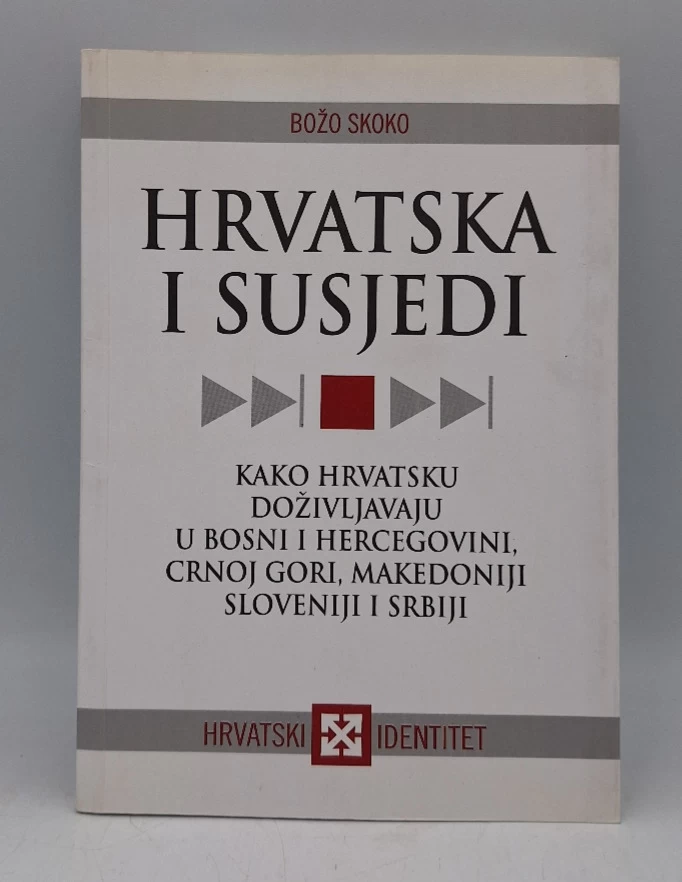
Hrvatska i susjedi
Basic information
- Author: Skoko Božo
- Publisher: AGM
- Availability: Available
- Condition: Very good
- Code: 77071
Shipping options
Payment methods
Explore more
Hrvatska i susjedi
Skoko Božo
Summary
Božo Skoko: Croatia and Neighbors
How Croatia is Perceived in Bosnia and Herzegovina, Montenegro, Macedonia, Slovenia and Serbia
The book "Croatia and Neighbors" deals with the mutual relations of the countries created by the breakup of the former Yugoslavia and scientifically investigates Croatia's image in the region..
Is Croatia truly a regional leader? How do the neighbors perceive Croatia and on what basis do they build their perception? How much did the wars burden the image of Croatia in Serbia? In which country is Croatia the most popular? What are the biggest Croatian "export" values? How do citizens who last visited our country in the 1980s perceive Croatia, and how do young people born during the war perceive Croatia? What historical stereotypes about Croats are still present in public opinion and which were "launched" by the war? Who do some nations consider responsible for all the evil that happened to us in the nineties? Why are the Adriatic Sea and the Croatian coast the biggest magnet for all peoples from the territory of the former state? Who do Macedonians, Serbs, Slovenes, Montenegrins and Bosnians and Herzegovina trust most in Croatia, and what do they know about our historical greats and what about Croatian efforts towards full membership in the European Union? How do the media in the region report on Croatia and how different is their image of Croatia from the public opinion of its citizens? These are just some of the questions that this book answers systematically, analytically and with many arguments.
The author conducted two very complex studies - an extensive field survey of public opinion, literally from "Vardar to Triglav" and an analysis of media coverage of Croatia in the six countries created by the breakup of Yugoslavia. It is also the largest such research ever conducted in our region, and the most attractive and important results are published in the book. How they come at the right moment is perhaps best evidenced by the fact that ten years have passed since the end of all conflicts on the territory of the former state and twenty years since the breakup of Yugoslavia and the beginning of the independent paths of the former republics.
This book gives us a clear picture of the impact that the breakup of Yugoslavia, Serbian aggression, the war in Bosnia and Herzegovina, and the defensive war in Croatia had on mutual perception, that is, with what prejudices and legacy we step into the future. The book deals with the countries with which until recently we shared the challenges of living together within the Socialist Federal Republic of Yugoslavia, and today they represent significant export markets, emitting tourist areas, and significant political and economic partners, with whom - due to geographical conditioning - we will share the future in these areas, within the European Union or independently of it. The image of Croatia in the region, that is, in the countries of the former Yugoslavia, is a topic that has not been discussed at all until now. In contrast to scientific disinterest in this issue, the opinion of Croatia's neighbors about the Republic of Croatia is becoming more and more important to it on its way to full membership in the European Union, during which it strives to play the role of a regional leader and expand its political and economic influence in the region.
The book is divided into two large parts. In the first, the relations between Croatia and neighboring countries are analyzed through the socio-historical context. The author takes us through the history of Croatia's "entry" into Yugoslavia, the advantages and disadvantages of living together, and traces the disintegration of the former state, the path to Croatian independence, the time of war and the aftermath. It particularly analyzes the political and economic cooperation between Croatia and the countries in the region and introduces us to the ups and downs in mutual relations. A special value is the systematic review of previous research into the image of Croatia and Croats in the countries of the region, as well as the research into the roots of "historical" stereotypes of Serbs about Croats, in the texts of Serbian intellectuals throughout history.
Additional information
- Author: Skoko Božo
- Publisher: AGM
- Year of publication:2010
- Place of publication:Zagreb
- Pages:195
- Dimensions:14x20 cm
- Script:Latin script
- Condition:Very good
- Binding:Softcover
Reviews
0 reviewsWrite a review
Share your experience and help other readers choose.
This item has no reviews yet. Be the first to share your experience.
More books by Skoko Božo

More books from AGM







You may also like