
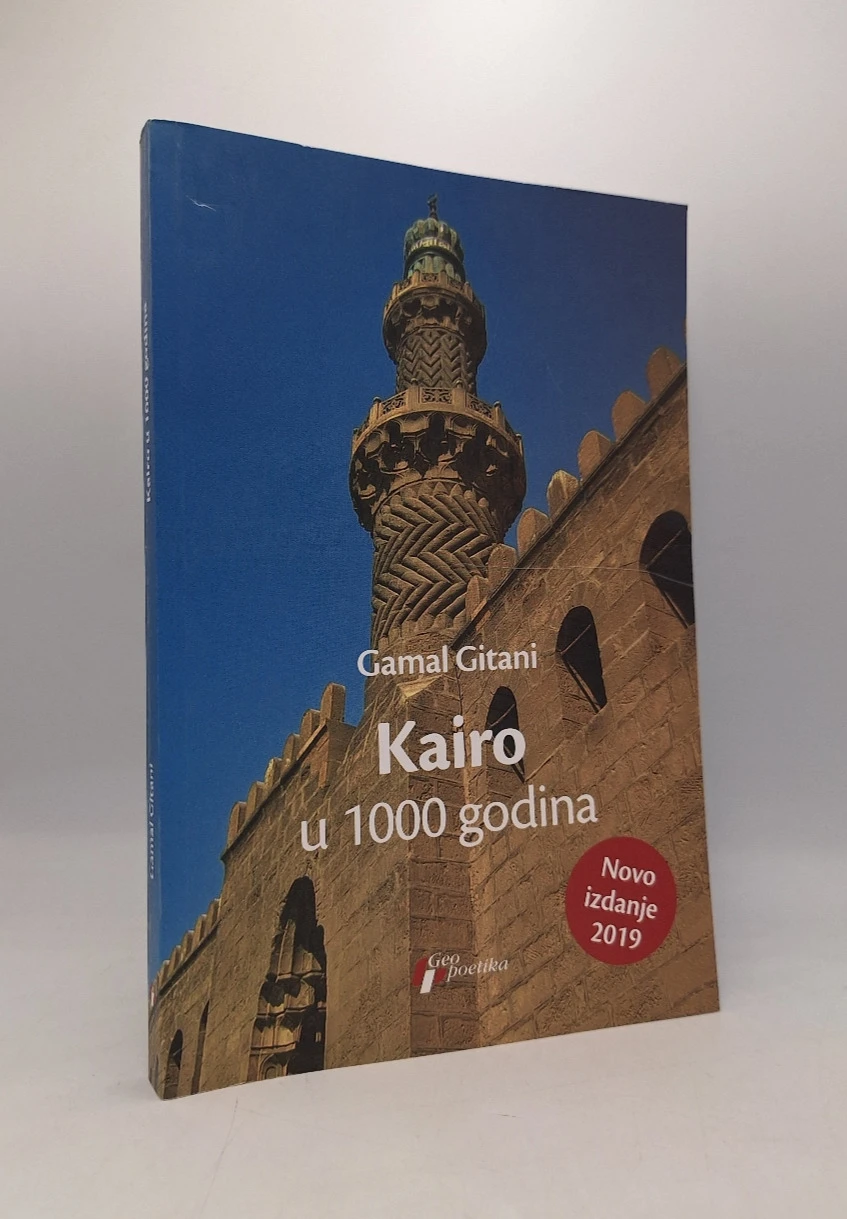
Kairo u 1000 godina
Basic information
- Author: al-Ghitani Gamal
- Publisher: Geopoetika
- Availability: Available
- Condition: New book
- Code: 80490
Shipping options
Payment methods
Explore more
Kairo u 1000 godina
al-Ghitani Gamal
Summary
Gamal al-Ghitani: Cairo in 1000 years
"The public was lucky and privileged to have one of the best Egyptian writers like Gamal el Gitani write a book about Cairo. His knowledge of this ancient city is so subtle that you could comfortably follow him blindfolded through the labyrinths of the city on the Nile. And when your eyes are open, and as you follow the pages of this text, it seems to you that the book is called Cairo in 1001 nights. What makes it so? Knowledge, love and language.
"Knowledge" is so sovereign that Gitani seems to be as old as Cairo.
"Love" is so much that you become jealous of the city. a literary-historical work, an intimate history of Cairo or the personal history of a writer who embraced and appropriated the city.
The twenty-two chapters of Gitani's Cairo are lined with cafes, tobacco and hookahs, turbans, horses, bazaars, slaves, mosques and minarets, houses, pyramids, Nagib Mahfouz's Cairo, arabesques and ornaments in construction and literature and, above all, people.
This book is a guide to everything. centuries and layers Cairo was originally created in 1997. It is complemented by an extensive introductory text in the summer of 2007 written especially for Geopoetica's edition."
Vladislav Bajac
"In Cairo in 1000 years Gitani stepped into the civilizational, cultural, historical and humanistic anatomy of the ancient metropolis. Allowing each stone and symbol to speak about its past and origin, the writer in the present time, he is searching for a sign that could predict the future of this city.
Gitani has so far published over ten collections of short stories and eight novels. He received the incentive state prize for young writers (1980), the most important pan-Arab literary prize - the Emirati prize "Oveis" (1997), and the French Order of the Order of Literature and the Arts (1987), and the French translation of his work Illumination In 2005, he received the award for the best translation. In the summer of 2007, he received Egypt's most significant award - the State Award for Merit in Literature. His works have been translated into ten languages. This is his first work translated into Serbian."
Dragana Đorđević
Additional information
- Author: al-Ghitani Gamal
- Publisher: Geopoetika
- Year of publication:2019
- Place of publication:Beograd
- Pages:253
- Dimensions:15.5x23.5 cm
- Script:Latin script
- Condition:New book
- Binding:Softcover
Reviews
0 reviewsWrite a review
Share your experience and help other readers choose.
This item has no reviews yet. Be the first to share your experience.
More books from Geopoetika