
Strabon iz Amasije
Basic information
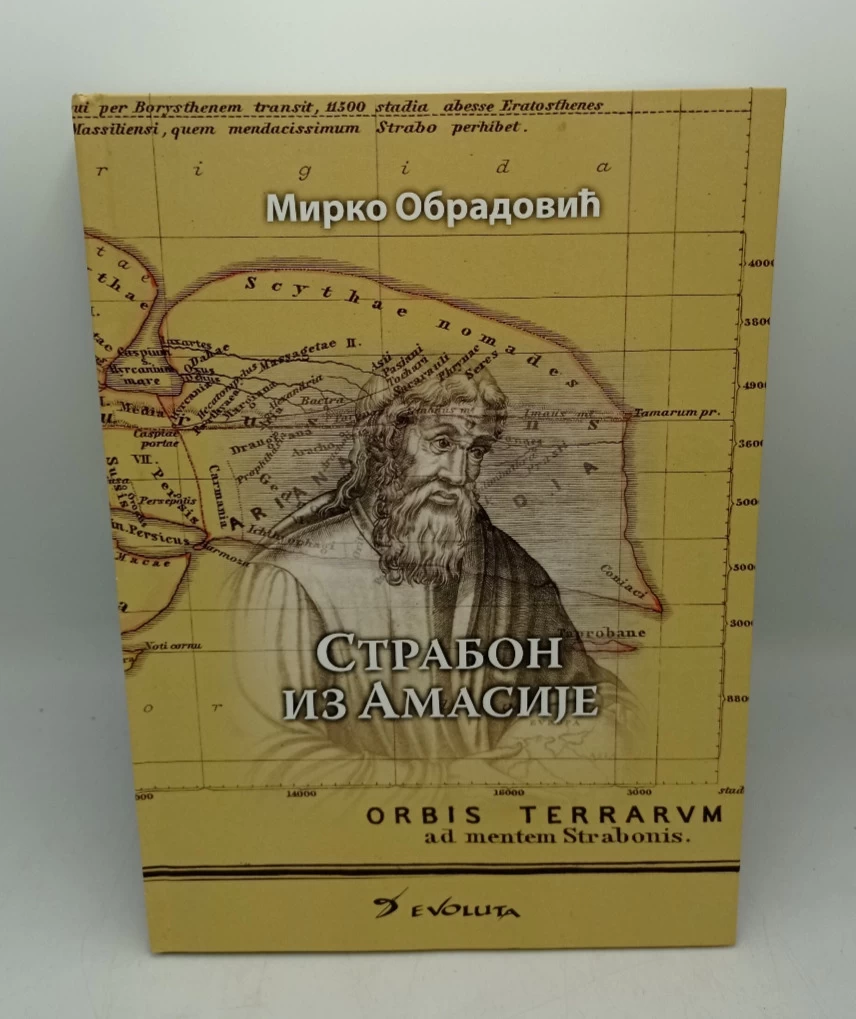
- Author: Obradović Mirko
- Publisher: Evoluta
- Availability: Available
- Condition: New book
- Code: 57096
Shipping options
Payment methods
Explore more
Strabon iz Amasije
Obradović Mirko
Summary
Mirko Obradović: Strabo from Amasia
The book Historian and geographer Srabon from Amasia with translation and commentary of the seventh book of Strabo's 'Geographies' is another monograph on ancient historiographers with professional translation and commentary on their texts, which occasionally, but unfortunately not so often, appear in our country. scientific and cultural environment. This monograph will be extremely useful to experts, and it will represent a great challenge for the reader who has not had the opportunity to become better acquainted with the details of the works of ancient historians.
Seventeen books of Strabo's geography are usually considered a comprehensive part of an undefined, at first glance not entirely clear genre, certainly of an encyclopedic character. The author sets himself the goal of describing ecumenism - the entire known inhabited country, and in this part he draws conclusions from the entire science of the Hellenistic era. According to modern researchers, the geography has a scientific value, because it represents the first attempt at a comparative criticism of the author's available sources and geographical data recorded by Strabo's predecessors, and, at the same time, strives for their systematic presentation in a consistent manner and in its entirety. It is a geographical work of a descriptive type, although consideration of the current question of the reliability of the judgments given by Strabo, if we keep in mind his characteristic method of researching sources and a certain limitation of his access to original data, could initially confuse and mislead the modern reader. Regardless of this specificity, the diversity and abundance of information about the countries and peoples known in Strabo's time and the Geography itself today make it one of the basic and most valuable sources for the study of the geography of the ancient world.
The manuscript of the monograph on Strabo from Amasia that is before us has two parts:
1. An introductory study of Strabo and his work, divided into seven chapters
2. Translation of the seventh book of Strabo's Geography.
The publication includes a list of selected professional literature, and in its conclusion there is a very useful index of Strabo's sources and names mentioned in the seventh book of the Geography.
In the introductory scientific research, the author adheres to the traditional structure and begins the monograph with Strabo's biography and presentation of the content of his historical work and Geography, in the form in which they are preserved to this day (chapters I - III), in order to dealt with the essential characteristics of Geography and Strabo's method of research (chapters I - III).
The chapter on Strabo's understanding of geography and the character of his work (chapter IV), in which the author presents Strabo as a researcher in the best light, emphasizes the importance of his scientific polemics with his predecessors and highly appreciates the accuracy of certain geographical data given in this part. This chapter points out that the Geography was intended primarily for the Roman social elite as a "handbook and guide for the practical politician and civil servant" and that it is primarily of a humane nature "where the data obtained by measurement and calculations are recorded only to the extent that it seems that the author can be useful to the people." The author believes that Strabo's geographical work is the closest to the genre of historical geography, in which the geographical space is not only viewed as a physical space, but its historical development and ethnography. Finally, this chapter pays attention to Strabo's specific attitude towards myth and quotes from ancient poets, especially Homer, which for him, as the author reminds us, have the same scientific value as history and quotes from professional prose writers.
In the last two chapters, the author analyzes Strabo's research method using specific examples. These chapters provide an overview of the ancient authors whose works Strabo used and discussed in the Geography (chapter V) and discuss Strabo's judgments about individual peoples and ethnic groups (chapter VI). With these chapters, the author dos slowly completes his analysis of Strabo's concept of historical geography.
The seventh book of Geography is especially important for our science and the wider readership. Describing the part of Europe between the Rhine in the west, the Danube in the south and the Don and the Sea of Azov in the east, Strabo in this book, as the author of the monograph points out, provides information about the areas south of the Danube and stretching between the Adriatic and Black seas. III). There is no doubt that the content encouraged the author himself to translate the seventh book and include it in this publication with appropriate professional comments.
The academic translation of the seventh book was done meticulously and fully meets the professional requirements of the profession. The style is simple and clear. Toponyms, ethnonyms and personal names are mostly consistently translated into the Serbian language. The only objection relates to the translator's frequent use of foreign words and modern terminology, which can disrupt the stylistic uniformity of the text and cause an impression of anachronism in reading this translation.
According to his approach to Strabo's work, this publication is acceptable and very useful for historians and classical philologists and can be unusually interesting to a wider audience of various interests. I think that, considering the topicality of its content for our cultural environment, with minor corrections, the new book about Strabo will be well received by readers.
Ana Petković
Additional information
- Author: Obradović Mirko
- Publisher: Evoluta
- Year of publication:2018
- Place of publication:Beograd
- Pages:319
- Dimensions:18x25 cm
- Script:Cyrillic script
- Condition:New book
- Binding:Hardcover
Reviews
0 reviewsWrite a review
Share your experience and help other readers choose.
This item has no reviews yet. Be the first to share your experience.
More books from Evoluta