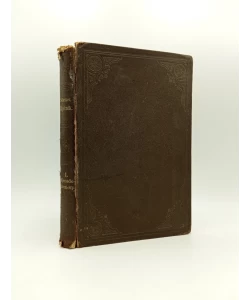


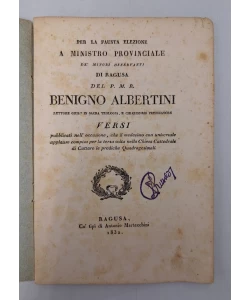
Vocabolario italiano-illirico-latino I-II
Basic information
- Author: Stulli Joakim
- Publisher: Martecchini
- Availability: Available
- Condition: Very good
- Code: 32529
Shipping options
Payment methods
Explore more
Vocabolario italiano-illirico-latino I-II
Stulli Joakim
Summary
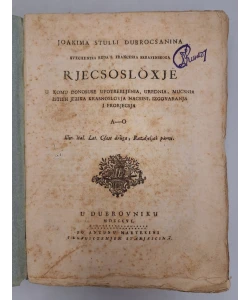
Joakim Stulli: Vocabolario italiano-illirico-latino I-II
In which they brought the used, orderly, eloquent language of the same language, idioms, pronunciations and prophecies
1. Lexicon Latino-Italico-Illyricum (1801); 2. Illyrian-Italian-Latin vocabulary (1806); 3. Vocabolario italiano-illyrico-latino (1810)
Joakim Stulli is the author of the largest dictionary in the history of older Croatian lexicography (4,721 pages in total). His dictionary, on which he worked for about half a century, has three parts, and each part consists of two volumes.
The dictionary is trilingual, and its parts are:
Lexicon latino-italico-illyricum (printed in Buda in 1801),
Rječoslojje Illyrian-Italiano-Latin (printed in Dubrovnik in 1806),
Vocabolario italiano-illyrico-latino (printed in Dubrovnik in 1810).
The starting language of the first part is Latin, the second Croatian, and the third Italian.
Stulli had difficulties with publishing the dictionary. After several unsuccessful attempts to print a dictionary in 1782, he turned to the Austrian Emperor Joseph II, who had plans to publish a single dictionary for all the Slavic peoples of the Monarchy with a single spelling and added German words. Stulli wrote in Dubrovnik-Dalmatian script. As the dictionary had to have the approval of the Austrian authorities and be usable in a wider linguistic area, in 1785 a special committee was elected in Vienna with the task of editing the dictionary. The commission decided that the dictionary could be published after reworking it in Slavonic script, which had been introduced a few years before in the folk schools of Croatia, Slavonia and Hungary at the time. It was also requested that German words be entered into the dictionary. Bishop Antun Mandić especially contributed to the final redaction and printing of the dictionary, with whose help Stulli revised the spelling and spelling of the Illyrian (Croatian) part of the dictionary. Marijan Lanosović, in agreement with the author, added German words to the Illyrian part of the dictionary, and Sebastijan conte d'Ayala corrected and completed the Italian-Latin part of the dictionary. In 1801, the first part of the dictionary was published in Buda, with a dedication to the Austrian emperor Joseph II. and at his own expense.
Stulli took the material for the dictionary from almost all Croatian dictionaries up to that time (Mikalji's, Habdelić's, Jambrešić's, Della Bellina's, Belostenčeva's...), from literary works, from works of oral folk literature, as well as from printed and manuscript works of various purposes and styles. Let us mention that he did not use Vrančić's dictionary and the works of certain important writers as sources, such as Marko Marulić, Hanibal Lucić, Petar Zoranić, Petar Zrinski, Fran Krsto Frankopan or Pavao Ritter Vitezović.
Although the basis of the Croatian language is Štokavian, the dictionary also contains the lexicon of the Chakavian and Kajkavian dialects as well as Old Slavonicisms, Russianisms, Bohemianisms, Polonisms, words of the Slovenian language and personal authors. coins. The author started from the belief that the Illyrian language is a Slavic language understood by all Slavs, so he wanted to make it richer. Stulli's dictionary was highly valued in the Illyrian period.
Additional information
- Author: Stulli Joakim
- Publisher: Martecchini
- Year of publication:1810
- Place of publication:Dubrovnik
- Pages:838+862
- Dimensions:21x27 cm
- Script:Latin script
- Condition:Very good
- Binding:Hardcover
Reviews
0 reviewsWrite a review
Share your experience and help other readers choose.
This item has no reviews yet. Be the first to share your experience.
More books by Stulli Joakim
More books from Martecchini


You may also like