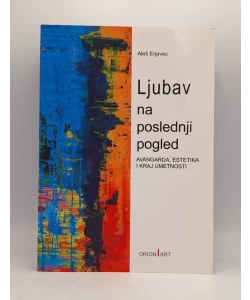
Estetske revolucije i avangardni pokreti 20. veka
Basic information
- Author: Erjavec Aleš
- Publisher: Orion art books
- Availability: Available
- Condition: New book
- Code: 41001
Shipping options
Payment methods
Explore more
Estetske revolucije i avangardni pokreti 20. veka
Erjavec Aleš
Summary
Aleš Erjavec: Aesthetic revolutions and avant-garde movements of the 20th century
It is time for a new state.
They say that you can find happiness there.
If we can agree that the avant-garde movements extend beyond the neo-avant-garde into the third-generation avant-garde, then the way is open for recognizing the further development of aesthetic avant-garde movements. Such a thought may be echoed in the following recent statement: "The desire to merge art and life resonates throughout the avant-garde movements of the 20th century, and then spreads across the planet at the beginning of the 21st century." Is there a future for avant-gardes, including aesthetic ones? Perhaps, only if they succeed in envisioning the future and creating a vision that will outweigh the atemporality of contemporary historical circumstances. The second condition may already be present: the avant-garde appears "in a time of instability and increased contingency". But the second necessary condition remains the same as a century before: a possible political avant-garde, with which art-historical projection can meet. After all, it was precisely the absence of a sympathetic political avant-garde that prevented post-historical avant-garde movements from becoming as visible and effective as earlier ones. Of course, we cannot see into the future, so such estimates are wrong or premature. Perhaps avant-gardes are really phenomena limited by modernity that authentically exist only within the framework of the 20th century, or perhaps somewhere on the planet at this very moment the fourth generation of aesthetic avant-garde is being born.
Additional information
- Author: Erjavec Aleš
- Publisher: Orion art books
- Year of publication:2016
- Place of publication:Beograd
- Pages:332
- Dimensions:17x24 cm
- Script:Latin script
- Condition:New book
- Binding:Softcover
Reviews
0 reviewsWrite a review
Share your experience and help other readers choose.
This item has no reviews yet. Be the first to share your experience.
More books by Erjavec Aleš
More books from Orion art books




You may also like