
Summary
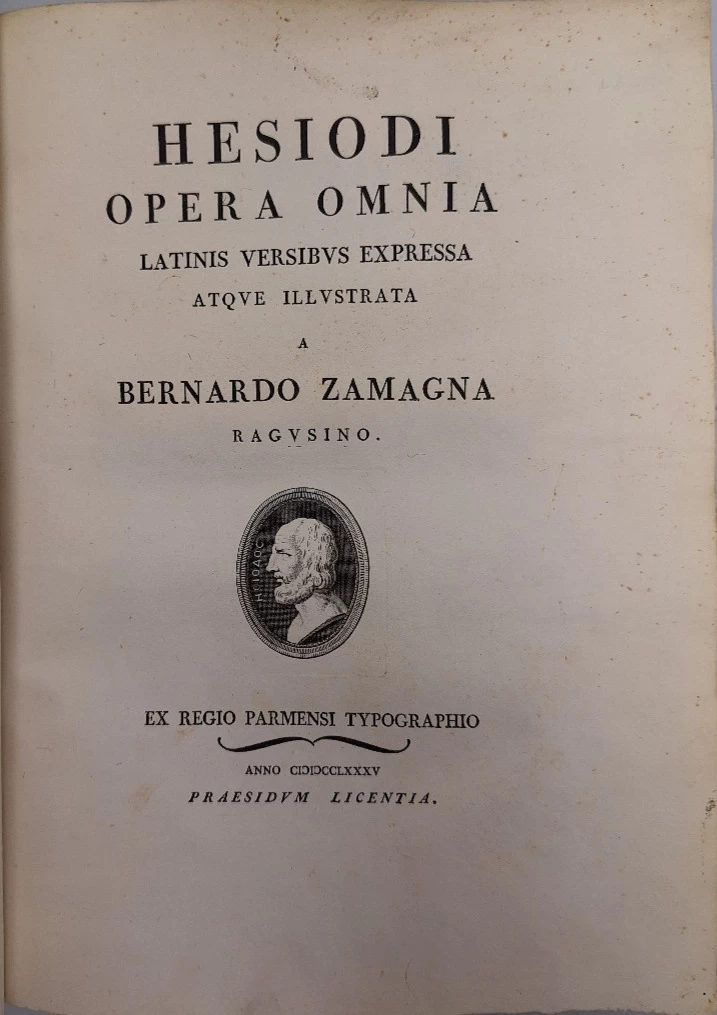
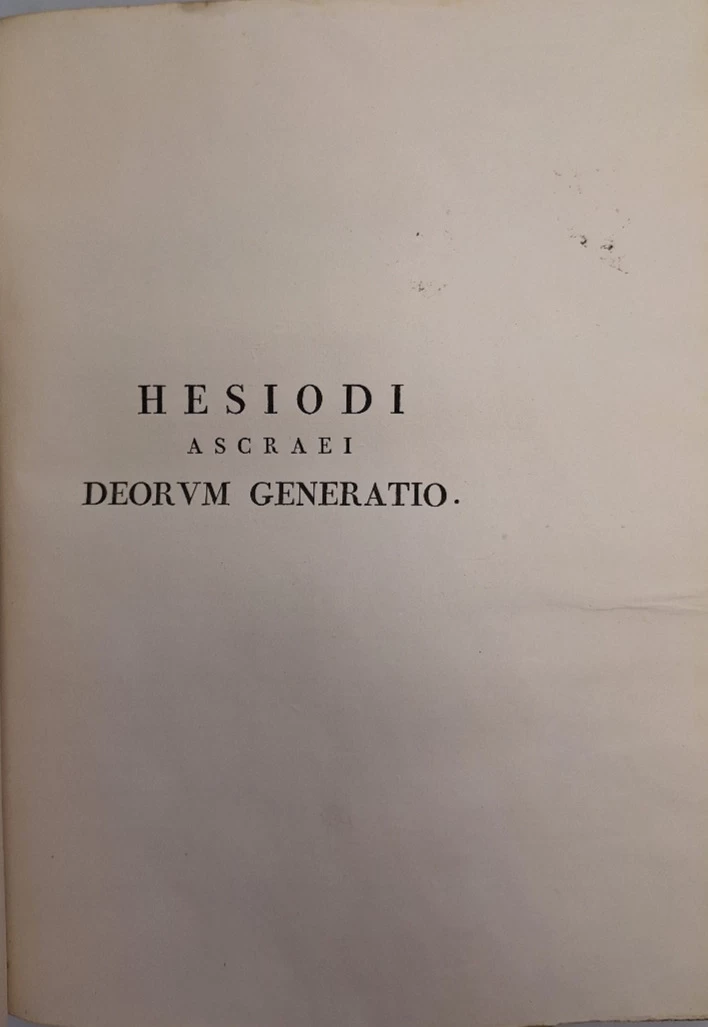
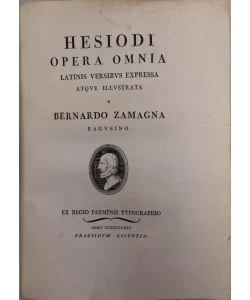
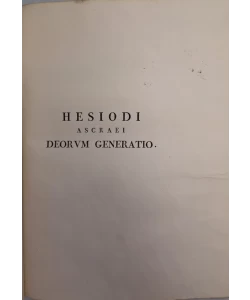
Hesiod: Esiodou tou askraiou ta euriskomena. Hesiodi Ascraei opera omnia.
Translation Bernard Zamanja
Zamanja (Džamanjić), Bernard (Bernardus Zamagna), Croatian poet and translator (Dubrovnik, 9. XI. 1735 – Dubrovnik, 20. IV. 1820). Attended the Jesuit Collegium Ragusinum; In 1753 he entered the Roman novitiate of the Society of Jesus. Studied rhetoric for two years (1755–57), studied philosophy (1757–60) and theology (1766–70). He was a student of R. Kunić and R. Bošković and a member of the Roman Accademia degli Arcadi (pastoral name Triphylus Caphissides). He was ordained a priest in 1769. He taught rhetoric at the Jesuit college Collegium Ptolemaeum in Siena, and after the dissolution of the Jesuit order, he continued to teach at the same institute under the Piarist administration. He taught rhetoric and the Greek language in Milan, where he served as a diplomat for the Republic of Dubrovnik. He was vicar general of the Dubrovnik archdiocese (1783); inspector of the Dubrovnik lyceum (1808). In the epic Echo (Echo, 1764), composed of 1361 hexameters in two books, he dealt with acoustic, meteorological and astronomical phenomena. He attached an elegy to the work Rajmund Kunić, his former teacher (Ad Raymundum Cunichium suum olim Magistrum), in which he wrote about the didactic orientation of the then Jesuit poetry workshop. In the epic Airship (Navis aëria, 1768), composed of 1473 hexameters, he spoke about an airship that would be propelled by means of four balloons. Along with the epic, a collection of ten Marian elegies was printed - One book of elegies (Elegiarum monobiblos). He is famous as a translator - he translated Odyssey into Latin, and following R. Kunić, along with the translation, he also published the translational treatise Principles of work (Ratio operis), in which he stylistically compared Iliad and Odyssey. He also translated all of Hesiod, accompanying the translations with extensive philological comments. He completed the translation of Theocritus (started by Kunić), prepared a complete Greek-Latin edition of Theocritus's Idylls, and published translations of the bucolics Moshe and Bion. At the end of XVIII. century he published a collection of hexameter epistles, and in one of them he argued for the rendition of Homer into the Croatian language. He sang Radonja by V. Menčetić and an excerpt from Osman by I. Gundulić from Croatian into Latin.
In the bilingual edition, on pages 5–16, there is also a hexameter dedication to Ferdinand of Austria, Peter Leopold's brother, to whom Zamanja dedicated the translation of the Odyssey. Virgil's influence is visible in the dedication, especially in the opening verses in which Zamanja imitates the beginning of the Aeneid. Zamanja accompanied the translation with an extensive commentary in which he interprets selected passages, explains some expressions (toponyms,
theonyms, epithets), cites ancient sources that speak about Hesiod (e.g. Lucian) and which he compares stylistically and content with Hesiod (e.g. Homer, i.e. Ovid) and in which he occasionally polemicizes with earlier translators and commentators (e.g. Le Clerc and his Phoenician etymologies), and I Hesiod is not spared from criticism of a meticulous Jesuit (among other things, because he confuses theogony with cosmogony)
The Latin translation of Theogony is one of the translation endeavors of our famous Latinist Bernard Zamanja. His interest in that archaic Greek epic is not surprising considering the time in which Zamanja creates, which is extremely favorable to instructive epics and epics that deal with the history and culture of peoples. In the preface to the translation, the breadth of Zamanja's education comes to the fore, as Zamanja shows great knowledge of the views of ancient and later authors and philosophers on Hesiod, as well as a good knowledge of Hesiod's life and works. In the preface, Zamanja also shows that he is a modern translator because he does not stand for a literal translation, but believes that the translator's task is to achieve a natural style in the language into which he is translating. When translating Theogony from Greek to Latin, Zamanja had to face language problems that reflect the differences between Greek and Latin, according to path of the frequency of use of particles, differences in the verb system and tendency to form compounds. When encountering Greek particles, Zamanja mostly decided to remove them completely, although he was generally inclined to expand the original text. One of the features of Zamanja's style was the avoidance of repetition. In his translation, expansion is much more common than shortening, and often includes expressions borrowed from earlier writers he read. In the preface to the translation, Zamanja emphasizes the desire to bring Hesiod's Theogony closer to the spirit of Latin epic poetry, so it is not surprising that he relies on the expressions and words of the Roman classics. The influence of the following Roman writers is particularly pronounced: Virgil, Ovid, Cicero, Silius Italicus and Lucretius. A thorough knowledge of their expression is the result of Jesuit education, which enabled Zamanjuda to express himself like a literary writer. As for authors closer in time, we can relate the text to the translation by Jean Le Clerc and the works of Ru-đer Bošković and Rajmund Kunić. Zamanja's translation of Theogony also reflects the neoclassical spirit of the times, and the translation is in some places more elegant than the original, and the author discreetly avoids misleading elements.

Biblos Newsletter
New titles, special copies and quiet recommendations from the antiquarian bookshop.