

Summary
Allason Thomas: Picturesque views of the Antiquities of Pola in Istria.
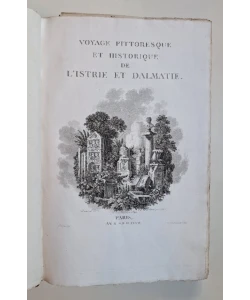
First edition. List of plates and vignettes at the beginning of the book – ten full-page etchings on inserted unnumbered sheets (plates) and four vignettes in the text, all with protective foils. The plates were engraved by W. B. Cooke, George Cooke, Henry Moses and Cosmo Armstrong. In addition to the illustrations from Pula, the Acropolis in Athens and the sea view of Trieste are shown. The author dedicated the book - the only one he wrote - to the Society of Dilettanti, of which he never became a member, which had long been interested in Pula and wanted to build its own building in Piccadilly modeled on the Temple of Augustus in Pula, but in the end it was abandoned. It was a society of nobles and scientists, founded in 1732, which sponsored the study of ancient art. Its members supported important expeditions to Greece and Turkey, which, among other things, resulted in publications that laid the foundations for the development of archeology as a serious scientific discipline. This philanthropic society still exists today, and its 60 members include distinguished scholars, curators and museum managers, owners of historical collections and historians. The book is divided into three parts. In the first, introductory part (Introduction, pp. [1] – 4), the author explains why he agreed to publish such a book: he wanted to bring the beauty of Pula's monuments to the public with his drawings and descriptions, but also their state of complete neglect, which he found after the short rule of the French. In the second part (pp. [5] – 22) he presents full-page graphics of the Amphitheater, the Temple of Augustus, a view of the back of the Temple of Augustus and Diana, the Arch of Sergius and the Double Gate. Each of them is accompanied by a detailed description that mentions their history and the condition at the time (descriptions of The Amphitheater (p. 12), The Two Temples (p. 14 – 16), Arch of the Sergii (p. 18 – 20), Gateway (p. 22)). In the third part (Remarks on the Ancient and Modern History of Istria and Dalmatia, Elucidatory of the Origin, Manners, and Customs of Their Present Inhabitants, pp. [26] – 67) he presents the history and geographical description of Istria and Dalmatia, as well as descriptions of the then population. He pays a lot of attention to the ancient history of the observed area. His detailed descriptions of the history and way of life of the Uskok, the way of life of the Hajduk, and a very detailed description of the life and customs of the Morlaks are significant. The author emphasizes that the itinerary shown in Voyage pittoresque et historique de l'Istrie et de la Dalmatie was of great help to him during the descriptions.

Biblos Newsletter
New titles, special copies and quiet recommendations from the antiquarian bookshop.