
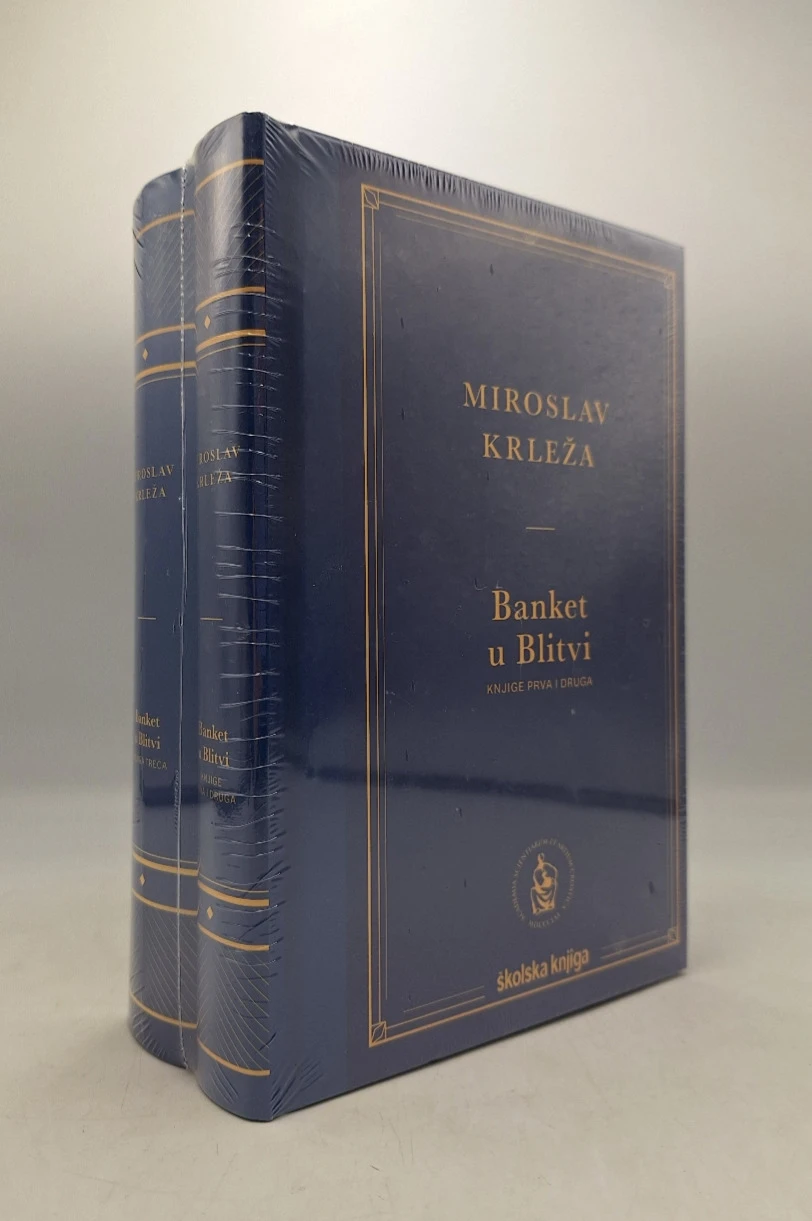
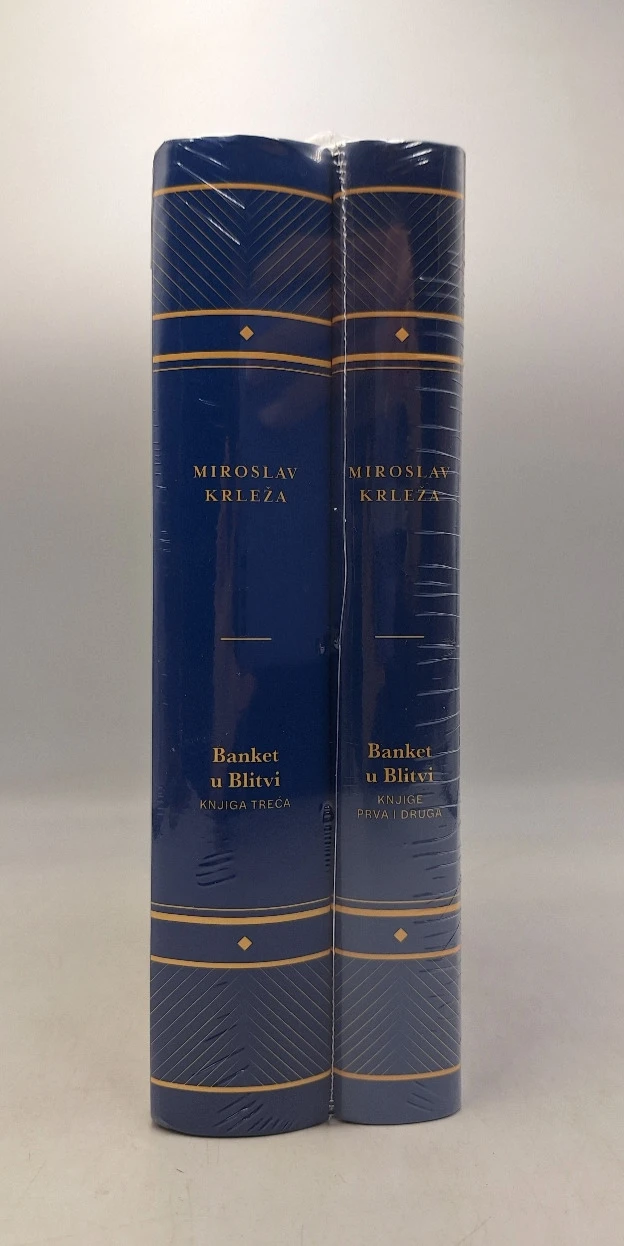
Banket u Blitvi
Basic information
- Author: Krleža Miroslav
- Publisher: HAZU | Školska knjiga
- Availability: Available
- Condition: New book
- Code: 84494
Shipping options
Payment methods
Explore more
Banket u Blitvi
Krleža Miroslav
Summary
Miroslav Krleža: Banquet in Blitva
The relationship between politics and morality – Krleža's old literary obsession – took on a completely new fictional guise in Banquet in Blitva. This work is distinctive both in its narrative and compositional solutions, as well as in its stylistic characteristics. In it, some elements that were less exploited in Krleža's narrative forms came to the fore. The first thing that catches your eye after reading the novel is an extremely rich, elaborate, intricate event line: action, accumulation of plots and excessive situations, and many unusual and unexpected twists and turns. If we were to enumerate everything that happens in the novel Banquet in Blitva, we would get the impression that it is a typical genre prose. Because everything is teeming with political intrigues, contract killings, suicides, political assassinations, espionage operations, persecution, jumping out of windows, police terror, conspiracies, bloody calculations, coups d'état... Streams of blood flow through the novel, and at the end of it all, on the Blitvin stage, as in some Shakespearean tragedies, a pile of corpses remains. Krleža adopted certain conventions and formal patterns of a criminal story, but enriched them with deeper content and philosophical meaning.
All the characters in the novel are drawn into the fatal circle of politics. In the first layer, Banquet in Blitva is a political thriller in which the struggle for power and the laying bare of the mechanism of the functioning of the government and the maintenance of power are at the center. Krleža has always been interested in political violence, "gorillaism", "bashing", state terror, tyranny. He saw how the monarchist dictatorship of King Alexander worked in Yugoslavia and dealt with these phenomena already in his political essays collected in the book Ten Bloody Years. And in the thirties of the 20th century, the European political scene was marked by the rise of totalitarianism, dictatorship and tyranny in a number of countries (fascism in Italy, National Socialism in Germany, civil war in Spain, Stalinism in the Soviet Union). The first, action phase in the operation of totalitarian movements was just taking place: the violent conquest of power by coup and then the creation of mechanisms for maintaining power.
With the rise of totalitarian systems and one-party militaristic dictatorships in the twenties and thirties of the 20th century, new models of political activity characterized by the accumulation, monopolization and expansion of power, aspirations for absolute control of society by creating a branched conspiratorial apparatus and organizing state terror came to the fore. oppressed by political opponents, and the broad masses kept in submission. In his political thriller, Krleža wanted to analyze in more detail those malignant historical processes that unfolded before his eyes on political stages throughout Europe. But he wanted to give the novel, which directly thematizes the invasiveness of the will for political power, a wider, symbolic dimension. He wanted to show that something deeper hides behind the ordinary and everyday, something that penetrates into the very foundations of anthropology, into atavistic drives and chaotic forces in human nature, into the heart of evil. Therefore, he raised his work above bare, literal reality and gave it transferred, universal meanings. After all, there have been tyrants and autocrats in all times... Therefore, in the Banquet in Blitva, he imagined a new geographical and geopolitical reality on the map of Europe and placed the action in it with an allusive political context seasoned with the realities of his time. The fictional countries of Blitva and Blatvija are the scene of action, and they are associated with a multitude of appropriate toponyms that point to the Polish-Baltic-Scandinavian, or more precisely, the Lithuanian-Latvian area. Some countries mentioned in the novel under strange names could possibly be deciphered on the basis of context and/or historical associations.
Thus Hunia refers to Hungary, the Mediterranean to France, Ingerlandia to Germany, and Great Normandy to Great Britain, but for toponyms such as Atlantis, Gypsy, Kobilia, Transilmengia, Coromandia or Courland it is difficult to find a suitable reference entity in the real world. The conflicts between Blitva and Blatvia, as well as their centuries-old identity disputes, clearly allude to Croatia and Serbia, and the citation of the lyrics of Blitva's patriotic songs also contributes to this, such as the romantic patriotic vigil "Blitva has not yet fallen to us while we live", the legionary song "Blitva brigade marched, marched" or the anthem "Oj, Blitvini, the voice of our grandfathers is still alive for us". That is why the work has been interpreted as an allegorized history of Yugoslav relations. In any case, geographical identification is not necessary because "Blitva is not a country, but a condition, a fate, a curse".
Additional information
- Author: Krleža Miroslav
- Publisher: HAZU | Školska knjiga
- Year of publication:2024
- Place of publication:Zagreb
- Pages:792
- Dimensions:15x21 cm
- Script:Latin script
- Condition:New book
- Binding:Hardcover
Reviews
0 reviewsWrite a review
Share your experience and help other readers choose.
This item has no reviews yet. Be the first to share your experience.
More books by Krleža Miroslav


You may also like