
Labilni položaj
Basic information
- Author: Fabrio Nedjeljko
- Publisher: Studentski centar
- Availability: Available
- Condition: Good
- Code: 42333
Shipping options
Payment methods
Explore more
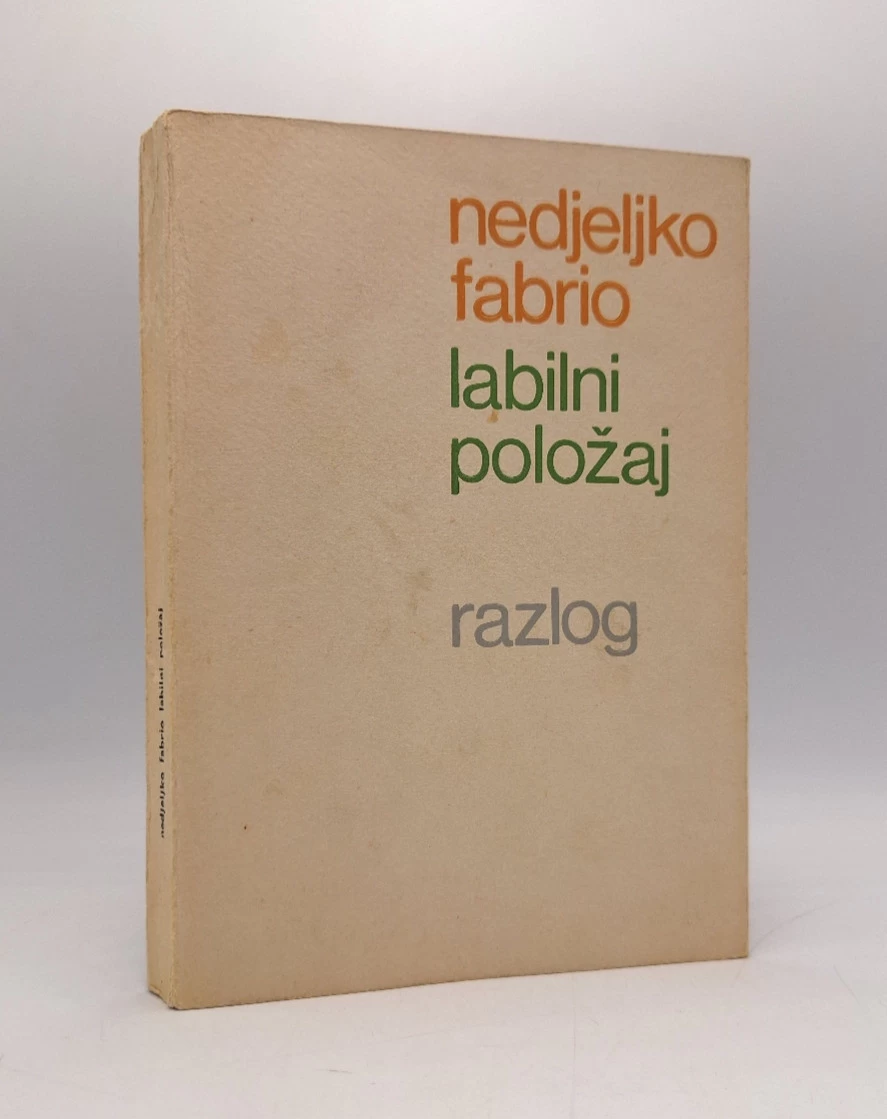
Labilni položaj
Fabrio Nedjeljko
Summary
Nedjeljko Fabrio: The Labile Position
*The book is underlined with a ballpoint pen.
Biblioteka Razlog
Equipment Mihajlo Arsovski
Fabrio, Nedjeljko, Croatian writer (Split, 14. XI. 1937 – Rijeka, 4. VIII. 2018). He graduated in Yugoslav studies and Italian language and literature in 1961 at the Faculty of Philosophy in Zagreb. Worked in cultural institutions in Rijeka (National University, Rijeka revija magazine, Ivan pl. Zajc HNK, Kamov monthly), and from the beginning of the 1970s lived and worked in Zagreb (editor of Croatian Television's drama program, lecturer at the Academy of Dramatic Arts). He was the president of the Society of Croatian Writers in 1989–95. He has been a regular member of HAZU since 1997. He won the "Vladimir Nazor" Lifetime Achievement Award in 2007.
He first appeared as a poet and novelist, then as a playwright, and in the mid-1980s as a novelist. In the dramatic part of Fabrije's oeuvre, the connection of historical themes and contemporary experiences prevails, most often in the form of a conflict between a prominent individual and a secular or spiritual authority (Reformers, 1967; Admiral Christopher Columbus, 1968; Do you hear pigs squealing in the summer house of our masters?, 1969; Meštar, 1970; The King is Sleepy, 1971; Magnificat, 1978). His novelistic process (Partite za prozu, 1966; Labilni požija, 1969; Lovlja usta, 1978; Izabrane povijetke, 1990) is based on the refinement of linguistic performance, experimentation with form and skillful fable that coincides with postmodernist tendencies. Postmodernist poetics is also the basis of Fabri's novels. Vežbanje života (1985) and Berenik's Hair (1989) belong to the branch of postmodernist historiographical metafiction and are hybrid structures in which the components of a historical and family (genealogical) novel and a coming-of-age novel are recognized. In the novel The Death of Vronsky (1994), Fabrio also mixes the conditional levels of textual reality and fiction in a typical postmodernist manner. The novel Triemeron (2002), defined as the "third part of the Adriatic duology", was reprinted in 2005 with Exercise of life and Berenice's hair under the collective name Adriatic trilogy.
Croatian-Italian touches are the central subject of Fabrije's literary history, literary criticism and translation activities. He was interested in topics from the history of Italian literature, especially writers (F. Tomizza, S. Slataper) who are by origin, native and thematically linked to the Croatian area, the phenomenon of Trieste literature and its connections with the Slavic world (Apennine essays, 1969; Štavljeni štiva, 1977). He adapted a number of prose works for theater and television, edited an anthology of the Italian short story Poslejnji dio puta (1984), translated the works of C. Goldoni, L. Pirandello, A. Moravia, Slataper and other Italian writers, and published several books of reviews and criticism on literary, general cultural, theatrical and musical topics (Odor Talia, 1963; Theatricals, 1997 The Master of the Winds, 2003 Children of Orpheus
Additional information
- Author: Fabrio Nedjeljko
- Publisher: Studentski centar
- Year of publication:1969
- Place of publication:Zagreb
- Pages:154
- Dimensions:14x19.5 cm
- Script:Latin script
- Condition:Good
- Binding:Softcover
Reviews
0 reviewsWrite a review
Share your experience and help other readers choose.
This item has no reviews yet. Be the first to share your experience.
More books by Fabrio Nedjeljko



More books from Studentski centar


You may also like





Recently viewed