
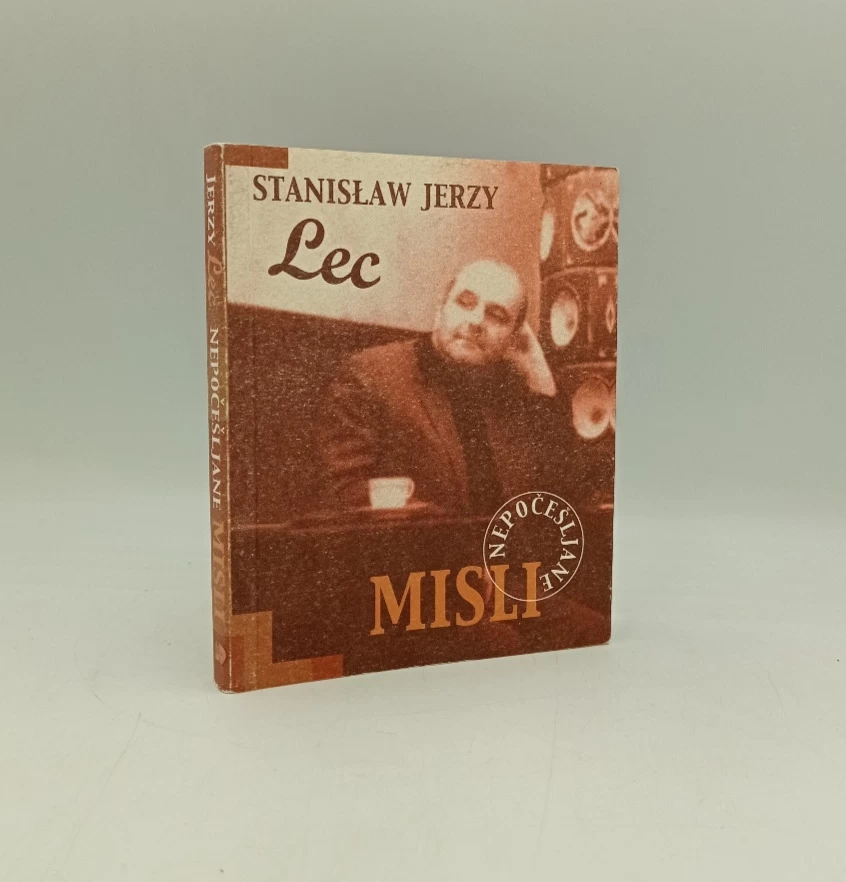
Nepočešljane misli
Basic information
- Author: Lec Stanislaw Jerzy
- Publisher: Šareni dućan
- Availability: Available
- Condition: Excellent
- Code: 49420
Shipping options
Payment methods
Explore more
Nepočešljane misli
Lec Stanislaw Jerzy
Summary
Stanislaw Jerzy Lec: Uncombed thoughts
I was sitting in a coffee shop one day. A strange feeling of anxiety came over me. You know that feeling! A person is then able to flip through the entire dictionary in search of the right word that would accurately name that feeling. My heart knew that something was missing.
Then someone approached me and asked: "Excuse me, did you happen to see Lec?"
And then I noticed that I wasn't there at all. I missed myself.
With these words of Lec, one of the collections of his uncombed thoughts begins, words that might seem unusual to someone who encounters his work for the first time. For a connoisseur of his thoughts, this is just one of his quips.
If we wanted to characterize his work and life with one word, Lec's brevity, the most suitable word would be lapidary.
He was a master of brevity, from his last name itself (he chose a shorter form of his last name, adapting it to the Polish script), all the way to the type of creativity he chose. Sam jokes about this brevity: Popularity? Hmm. Already at a nearby hairdresser you can hear: "Mr. L.? Of course I know him. He cuts his hair short." And his life was also short. Nevertheless, the brevity of his work and life did not take anything away from its content.
He was born on March 6, 1909 in Lviv. His mother was the daughter of a landowner, while his father was the son of Baron de Tusch-Letz, whose family traveled, as the biographer writes, "the mythical journey of the Jewish diaspora from Spain, Germany to the Slavic countries".
Stanisław Jerzy Lec made his debut with the poem Proljeće in 1929, and like most young poets, he published his first verses in magazines.
In 1933 he received the title of Master of Laws, simultaneously publishing the first collection of poems by Boje (Barwy). The cities with which his life is connected are Lviv - where he grew up, Krakow - where he made his debut as a writer and Warsaw - where he spent most of his life and where he got married. The war found him in Lviv. His original commitment was left-wing, which was reflected in his work. Thus, he published his poems in the Red Banner (Czerwony sztandar) and in Nowe Widnokregi (Nowe Widnokregi), and at one time his poem Stalin was noted.
After his arrest in 1941, he was imprisoned for two years in a concentration camp in Tarnopol, from where in 1943, escaping from certain death (he escaped just before the execution after digging his own grave), disguised as a German soldier, he ended up in Warsaw, where he joins the resistance movement, and in 1944 joins the Polish army.
After the war, he rebuilds the famous satirical magazine Pribadače (Szpilki). Then he published collections of satires and epigrams Spacer cynika and Notes from the battlefield (Notatki polowe). As press attaché of the Polish People's Republic, he went to Vienna in 1946 with his wife and children. In 1948, he published the collections Life is an Epigram (Życie jest fraszką) and Epigrams and Satires, and in 1950 the selection of lyric poems New Poems (Nowe wiersze). He leaves Vienna and goes with his family to Israel, where he stays until 1952. This unusual action was met with hostility both in Israel and in Poland. This was enough for his books to be banned and withdrawn from libraries, and he himself stopped publishing his works for the next few years. At that time, not only his works but also his biography were subject to censorship.
However, he did not find himself in Israel. Nostalgic for Poland, although aware of the Stalinist times, he returns to his homeland with his son in the midst of the fiercest Stalinism. Writing Uncombed Thoughts, which he began to publish regularly in newspapers from 1955, enabled him to express himself in a new way. Critics of his work emphasize that the "invention" of Uncombed Thoughts was not only a creative act but also a recipe for a philosophy of life. This "invention" also brought him fame. Although a lot of time has passed since his death (Lec died on May 7, 1966), new, as yet unpublished Uncombed Thoughts, which he used to write down on a napkin, are constantly appearing.
but also accounts in the cafes where he would drink his daily coffees. His aphorisms were already very well known at the time, and he himself entered the anthology of world aphorisms.
In this book, we publish a selection from one of the last updated collections of Uncombed Thoughts (1996 edition). Enjoy reading Lec's Thoughts! If after the first reading the thought you read seems simple, read it a second time, and you will notice the second and third levels as well. When your thought seems too complex, remember Lec's words: Some people do not follow my thought in the right direction. I followed the trail of one of my readers and returned only after three days. Lec warns us in a slightly sarcastic way not to look for depth where there is none or, which is typical for him, that he himself does not take responsibility for the interpretation of his thoughts.
Lec is a very demanding author. His puns sometimes demand erudition from the reader. The lapidaryness of Lec's aphorisms often reduces the thought to one word, the depth of which we must look for in the circumstances in which it was created. Apparent simplicity is only a disguise for the multi-layered associations. Rarely can the reader be satisfied with the "discovery" of two levels. There is usually one more, and more... The translator of his aphorisms had to discover all the levels in order to be able to faithfully transfer them to another language and culture, and where this is impossible, give up the least important level.
It is also characteristic of Lec's aphorisms that, although critics have managed to classify them and thematically systematize them, they do not obey such an order. His thoughts came to him, and so they were written down. It is difficult to arrange them thematically, although the author's preference for some topics is visible. That's why we won't arrange them in any order here either, but will leave them as the author imagined them - uncombed, whatever that word hides.
Barbara Kryżan-Stanojević
Additional information
- Author: Lec Stanislaw Jerzy
- Publisher: Šareni dućan
- Year of publication:2002
- Place of publication:Koprivnica
- Pages:176
- Dimensions:12x15 cm
- Script:Latin script
- Condition:Excellent
- Binding:Softcover
Reviews
0 reviewsWrite a review
Share your experience and help other readers choose.
This item has no reviews yet. Be the first to share your experience.
More books by Lec Stanislaw Jerzy
More books from Šareni dućan


You may also like