

Nepočešljane misli 2
Basic information
- Author: Lec Stanislaw Jerzy
- Publisher: Šareni dućan
- Availability: Available
- Condition: Excellent
- Code: 44421
Shipping options
Payment methods
Explore more
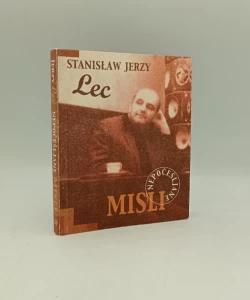
Nepočešljane misli 2
Lec Stanislaw Jerzy
Summary
Stanislaw Jerzy: Uncombed Thoughts 2
The second collection of aphorisms by Stanisław Jerzy Lec (1909-1966) published by the Colorful Shop should remind us of the existence of the first one, published in 2002. At the same time, it should remind us of Lec himself, so that we don't lose the writer who, regardless of the passage of time, remains current and fresh with his messages. And we should never lose sight of him.
Everything that needed to be said about Lec was already said in the afterword of our first book. The brevity of Lec's aphorisms, which the author himself often associated with the brevity of his surname, also imposes a number of limitations. It seems that everyone who writes about Lec is aware of this. Bearing in mind the brevity of his aphorisms, even when it comes to the Author's biography, they feel restrained and determined by his brevity. It is probably because of this that it is difficult to find a more comprehensive biography of Lec, although the greatness of the writer, as well as the wealth and content of his life, provide plenty of material. And although Leco's biography in itself could be material for a biographical work, in which one could find elements of all literary genres - from tragedy and drama to comedy or even farce, we often come across rich analyzes of his aphorisms rather than the author's biography.
Connoisseurs of Leco's oeuvre emphasize the author's connection with the epoch in which he created, with the years of socialist reality, perverted ideas. This could lead one to think that with the fall of totalitarian systems and the loss of historical context, Lec's aphorisms will remain in the sphere of the past, that their value will fade with the advent of democracy, preserving only the historical dimension. It would probably be like that if thoughts were one-dimensional. What should definitely be emphasized, and what has already been said, is the multi-layered or multi-dimensionality of Lec's aphorisms, while the secret of their success and genius is certainly their universality.
The passage of time, it seems, justifies a new approach to the written work. A new edition and a new introduction are often accompanied by a new perception. In the case of Lec, it is not about a new approach, but about emphasizing the universality that is sometimes hidden by what is related to the current. It is the universality that allows Lec's aphorisms to be read over and over again, with a constant sense of topicality and wisdom that transcends time, and the reader has a sense of its existence, although he can barely sense its depth.
The presence of Lec's aphorisms in new media perhaps best confirms their universality. Although Lec created unaware of the arrival of the Internet, his writing style seems to have been created for this type of media. It seems that precisely brevity, expressiveness, the possibility of multi-layered interpretation gives Lec's thoughts additional power. In a simple search of Polish websites using the Google search engine, we come across a number of links (first search 700 links) on which Lec's aphorisms appear. It is also interesting that only a few of them contain a fairly unified circulum vitae. Obviously, the average reader is much more interested in his oeuvre, which is so attractive that it is quoted on every possible occasion, than the writer's biography. So, on the Internet there are pages arranged by topic, arranged alphabetically, there are Lec's aphorisms alongside other aphorisms, there are selected quotes for a certain occasion, and there are completely unordered - "uncombed" thoughts. Collections of Lec's thoughts can be found in online libraries, on private pages of favorite sayings, etc.
In addition to the messages they send, which order to stop and think about an apparently carelessly thrown thought, Lec's thoughts have also become the kind of wisdom that is good to put as a motto for a literary work, a scientific work or a public performance as a hint of the depth of the work that follows.
And since we have already given up on listing Lec's biography, let's follow the message of the Author himself, who says:
From one writer's sentence, it should be possible to reconstruct the entire writer, just as its proportions, size and shape can be read from the bones of a prehistoric animal.
So let's read Lec in order to read his greatness and value, his spirit from his aphorisms.
Barbara Kryżan-Stanojević
Zagreb, May 2006.
Additional information
- Author: Lec Stanislaw Jerzy
- Publisher: Šareni dućan
- Year of publication:2006
- Place of publication:Koprivnica
- Pages:172
- Dimensions:13x15 cm
- Script:Latin script
- Condition:Excellent
- Binding:Softcover
Reviews
0 reviewsWrite a review
Share your experience and help other readers choose.
This item has no reviews yet. Be the first to share your experience.
More books by Lec Stanislaw Jerzy
More books from Šareni dućan


You may also like