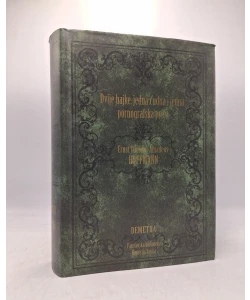

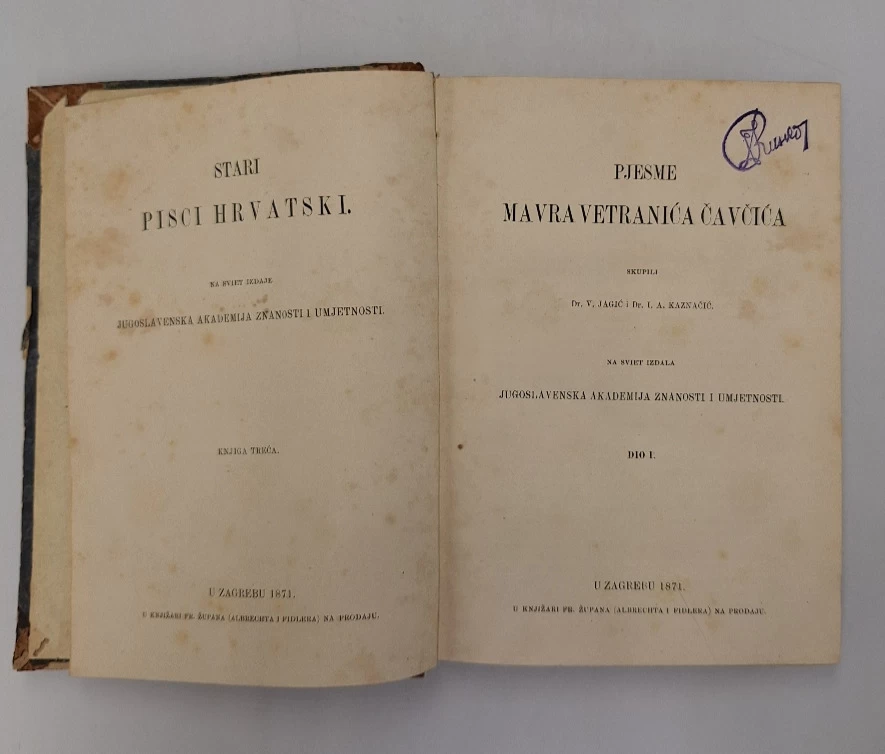
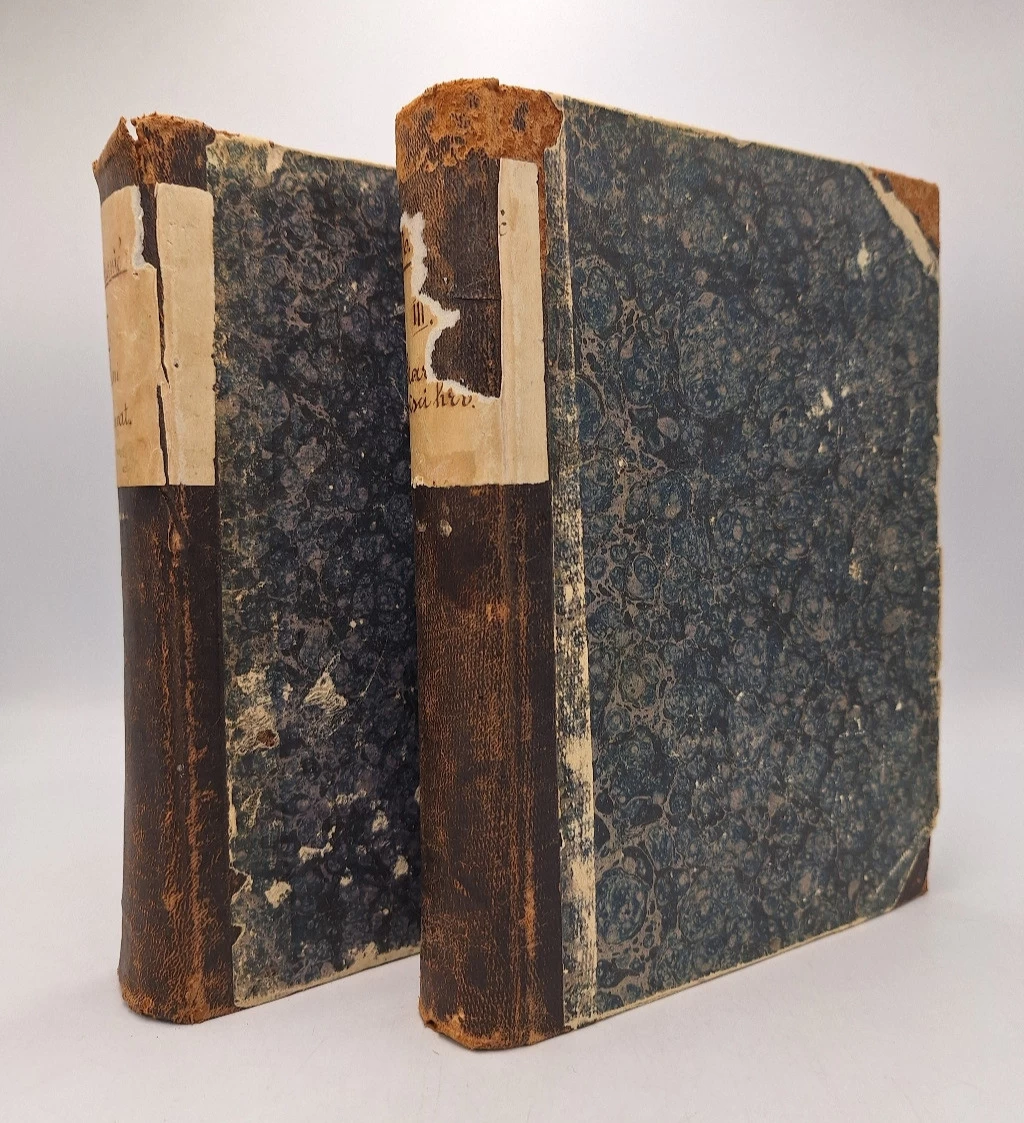
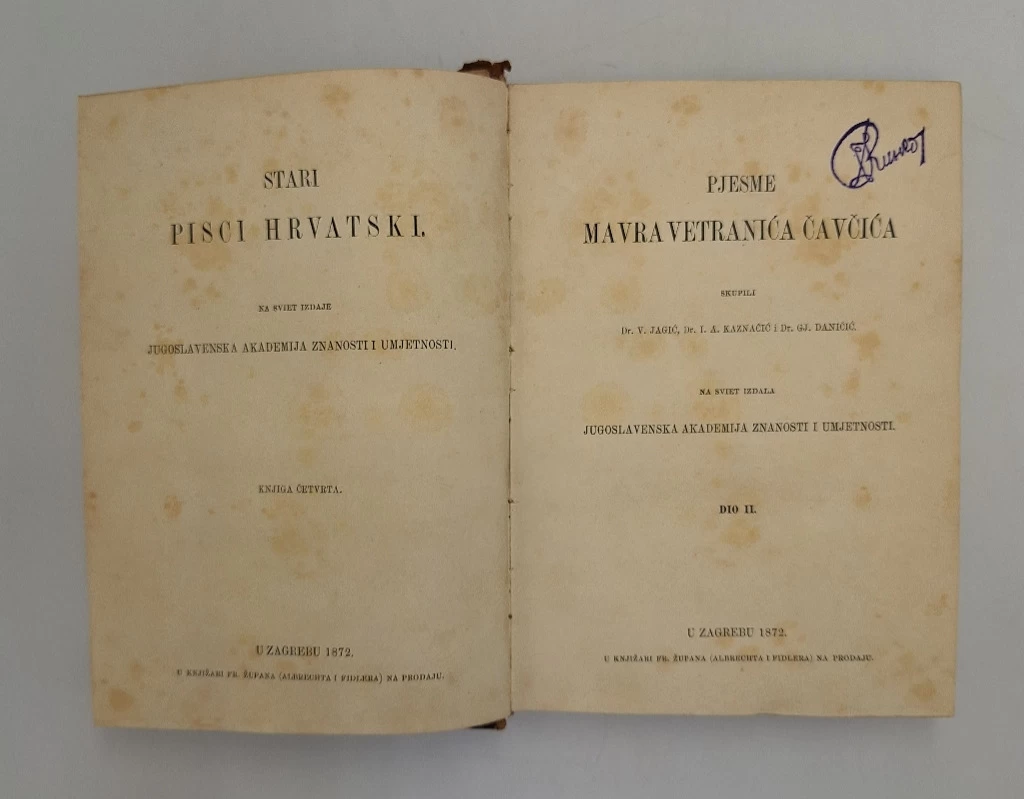
Pjesme Mavra Vetranića Čavčića
Basic information
- Publisher: Jugoslavenska akademija znanosti i umjetnosti (JAZU)
- Availability: Available
- Condition: Very good
- Code: 16450
Shipping options
Payment methods
Explore more
Pjesme Mavra Vetranića Čavčića
Summary
Poems by Mavr Vetranić Čavčić part II
Old Croatian writers
Collected by: V. Jagić and I.A. Kaznačić
Vetranović, Mavro, Croatian writer (Dubrovnik, 1482 – Dubrovnik, January 15, 1576). He comes from a family of Italian origin. He was baptized as Nikola, and Mavro is his religious name. His family nicknamed him Čavčić. He received his first education in the Dubrovnik city school, and then in the Benedictine monastery in Mljet. Older Croatian historiography stated that he studied in Italy, but it seems that there was a misinterpretation of some of the statements. Around 1507, he entered the Benedictine order, and was ordained in 1509. In 1515, Bishop A. Nalješković assigned him, along with three other monks, to reform the monastery in Mljet. Probably due to disagreements over the implementation of the reform, Vetranović, without asking for permission, went to Italy in 1517, for which the Dubrovnik government exiled him for life. However, he was pardoned and returned to Lokrum in 1522. He then held various positions in the Benedictine monasteries of the Republic of Dubrovnik: in 1524 he was the abbot of Mljet, in 1527 he was the head of the united monasteries of St. Andrija i Višnjica, 1534 (and maybe earlier) prior on the island of St. Andrija, where he was the only resident, in 1541 the abbot of Višnjica, in 1545 the president of the Mljet congregation and the abbot of Mljet. He was buried in St. Jakov on Višnjica. He enjoyed a great reputation among Dubrovnik writers, and his poetic skill was praised by M. Držić in the prologue of Tirena. He did not print anything during his lifetime. His opus includes between 30 and 40 thousand verses, preserved in several separate smaller manuscripts and in three extensive manuscript "books", marked with numbers 4 to 6, which would mean that the first three were lost. According to some lines from his Poems in the Time of the Pilgrims, written most likely for the plague epidemics in Dubrovnik in 1527 or 1533, and from the prologue of Držić's Tirene, it can be concluded that he wrote love poetry in his youth, but it has not been preserved. His opus is diverse in genres. Although there is no reliable information on the chronology of the creation of individual works, the assumption has become established in literary historiography that in his younger days he also wrote shorter dramatic texts with secular themes: two pastoral-mythological plays, History of Diana and Hunter and Fairy and a mythological drama about Orpheus and Eurydice, later titled Orfeo, a Christianized dramatization of the myth in which is, unlike the template, not Orfeo but Eurydice. Church depictions are probably the fruit of Vetranović's mature years. The depiction of From the Resurrection of the Resurrection belongs to the Easter cycle and depicts Christ's descent into hell. Christ's birth was dramatized in The Story of the Birth of Jesus, performed in 1537. He elaborated the Old Testament story about Joseph of Egypt into a comprehensive Story of how the brothers sold Joseph, and Abraham's sacrifice of Isaac in the Abram's Sanctuary, shown in 1546, preserved in five different versions. The Old Testament book Daniel is based on Pure Susan, a biblical drama that deviates from the structure of the presentation. Vetranović's lyrics are very diverse. It is difficult to precisely determine the theme and genre affiliation of many songs, because they are extremely long and include different thematic interests and different tones. He wrote religious poems, masquerades, political and satirical poems, a lament (The complaint of the city of Buda), a series of reflective poems, tombstones. He is the author of the first epistle from Dubrovnik addressed to a writer from Hvar (P. Hektorović). Vetranović is the only Dubrovnik poet of the 16th century who was intensely interested in current social and political events and commented on them in verse, and one of the few who criticized the Catholic Church and the corruption of Dubrovnik society (especially the judges in Remeta) in verse. With the poet Marin Držić to the rescue he defended the young Držić against accusations that he was a plagiarist. It is characteristic of many of his songs that they are sung in the first person in and that they combine reflections on their own intimacy, especially on religious feelings and the position of man in the world, with the problematization of contemporary political events, whereby didacticism and preachy discourse are added to the intimate narration. The allegorical epic Pilegrin (4374 doubly rhyming twelfths) is the first and only extensive narrative work in Dubrovnik in the 16th century. It deals with the unusual, fantastic journey of the title character Pilgrim, whose goal is unclear and which should obviously be understood as an allegorical journey. Apart from a few songs in octaves, of which the particularly important ones are Pjesanca u počaj poetam and two songs entitled Remeta, most of Vetranović's works are sung in double rhyming twelves. His works are mostly preserved in copies from the 17th century. century, some even in younger copies, and up to the second half of the 19th century. century were not printed, except for a shorter version Abram's Sanctuary printed in 1616 in Naku karstjanski by M. Divković under the title Versi od Abram. Literary historiography of the 19th century. century mixed the works of Vetranović and Držić. Hecuba by M. Držić was published under Vetranović's name, and The Story of the Birth of Jesus and The Shrine of Abramovo under Držić's. Although he belongs to the Renaissance poets according to his age, Vetranović, compared to his contemporaries, seems closer to the poetics of medieval literature. On the other hand, the inability of his oeuvre to fit into the dominant poetic trends of Dubrovnik Renaissance literature, hard-to-determine genre affiliation, occasional problematization of the relationship between literature and reality, and metatextual excursions earned him the label of a mannerist writer (P. Pavličić).
Additional information
- Publisher: Jugoslavenska akademija znanos...
- Year of publication:1871
- Place of publication:Zagreb
- Pages:483+490
- Dimensions:16.5x23.5 cm
- Script:Latin script
- Condition:Very good
- Binding:Hardcover
Reviews
0 reviewsWrite a review
Share your experience and help other readers choose.
This item has no reviews yet. Be the first to share your experience.
More books from Jugoslavenska akademija znanosti i umjetnosti (JAZU)

You may also like