
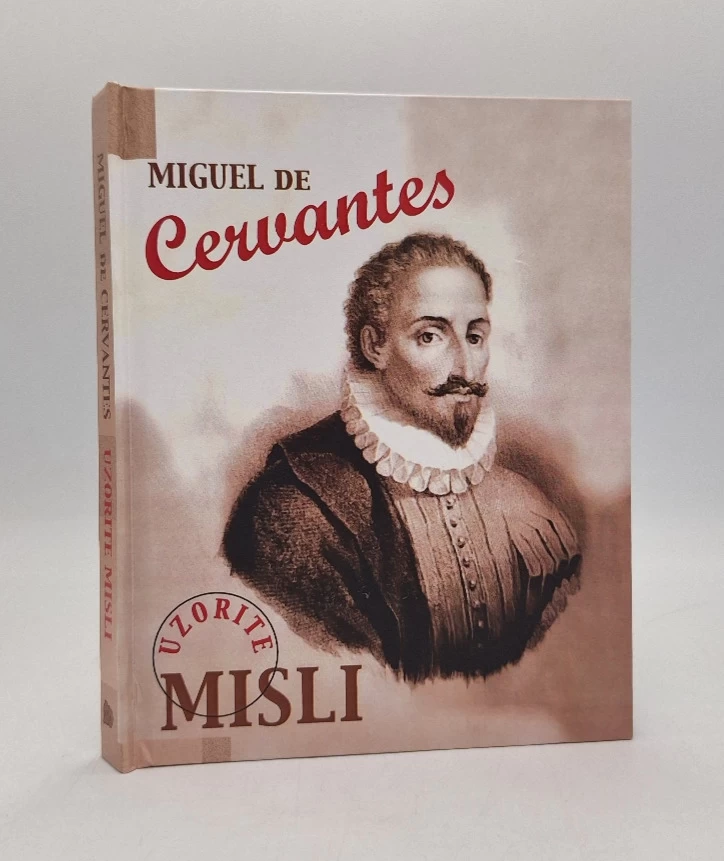
Uzorite misli
Basic information
- Author: Cervantes de Miguel
- Publisher: Šareni dućan
- Availability: Available
- Condition: Very good
- Code: 44419
Shipping options
Payment methods
Explore more
Uzorite misli
Cervantes de Miguel
Summary
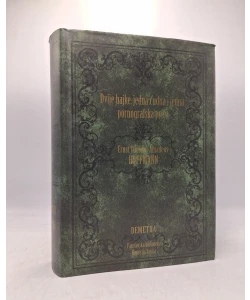
Miguel de Cervantes: Exemplary thoughts
This book contains the thoughts of one of the world's greatest writers, whose Don Quixote his admirer and literary successor F. M. Dostoevsky said was "the greatest and last word of the human mind and the bitterest irony that a man can utter". Don Quixote is not only the most important book of the golden age of Spanish literature, but also probably the most important book ever written in the Spanish language. Her inexhaustible humor and linguistic richness always delight us again. This unique novel is above all an ode to freedom and man's right to dreams, and freedom is its semantic and morphological axis. Behind the simple story of a nobleman from La Mancha who went crazy from excessive reading of chivalric novels, began to believe that he was a knight-errant and goes from adventure to adventure doing crazy things until one day he recovers, hides the world's first polyphonic novel (Todorov) which influenced a number of world writers, painters and other artists. In addition to the story of the famous knight, Cervantes also wrote Galatea, a pastoral novel in prose and verse that he called an eclogue, and a love-adventure prose entitled Persil i Sigismunda. With exemplary novellas, he introduced a short story into Spanish prose that resembles the Italian novellas modeled after Boccaccio.
Since he created in the period between the Renaissance and the Baroque, Cervantes necessarily relies on that part of the tradition, but also follows contemporary events. Like many other writers of his period, at first he devoted himself to writing verses. They are mostly epistles and occasional songs in a laudatory or satirical tone. He sometimes includes his poems in prose works (for example, in Galatea there is a long poem of Calliope, which consists of 111 octaves in elevenths with consonant rhymes).
He also successfully tried his hand at writing works for the stage. In his youth, he sold about thirty of his plays to theater companies that were shown in Madrid. Two of his works have been preserved from the first period, when comedy and tragedy are clearly distinguished in Spanish dramaturgy: The Darkening of Algiers and The Siege of Numancia. In them, he skilfully describes events from everyday life. In the work Eight Comedies and Eight Interludes (1615), "realizing that time changes things and perfects art," Cervantes adapts to the so-called new comedy, whose settings were formulated by Lope de Vega. He was particularly impressed by the short one-act plays that were performed in the breaks between the acts of a work.
Miguel de Cervantes never disclosed a book of his thoughts and aphorisms, although he wanted to and intended to do so. Namely, in the work of Persil and Sigismund, published after his death, an eyewitness pilgrim (Cervantes' alter ego) talks about his intention to publish a book entitled The Flower of Pilgrim's Aphorisms in which he would collect "sentences that contain truth". At least that's what university professor Aldo Ruffinatto claims, who edited and published a book under that title (Flor de aforismos peregrinos, Madrid: Círculo de Lectores, 1995), from which part of the quotations we present in this work are taken.
Željka Lovrenčić
Additional information
- Author: Cervantes de Miguel
- Publisher: Šareni dućan
- Year of publication:2014
- Place of publication:Koprivnica
- Pages:156
- Dimensions:12x15 cm
- Script:Latin script
- Condition:Very good
- Binding:Hardcover
Reviews
0 reviewsWrite a review
Share your experience and help other readers choose.
This item has no reviews yet. Be the first to share your experience.
More books by Cervantes de Miguel
More books from Šareni dućan




You may also like




Recently viewed