
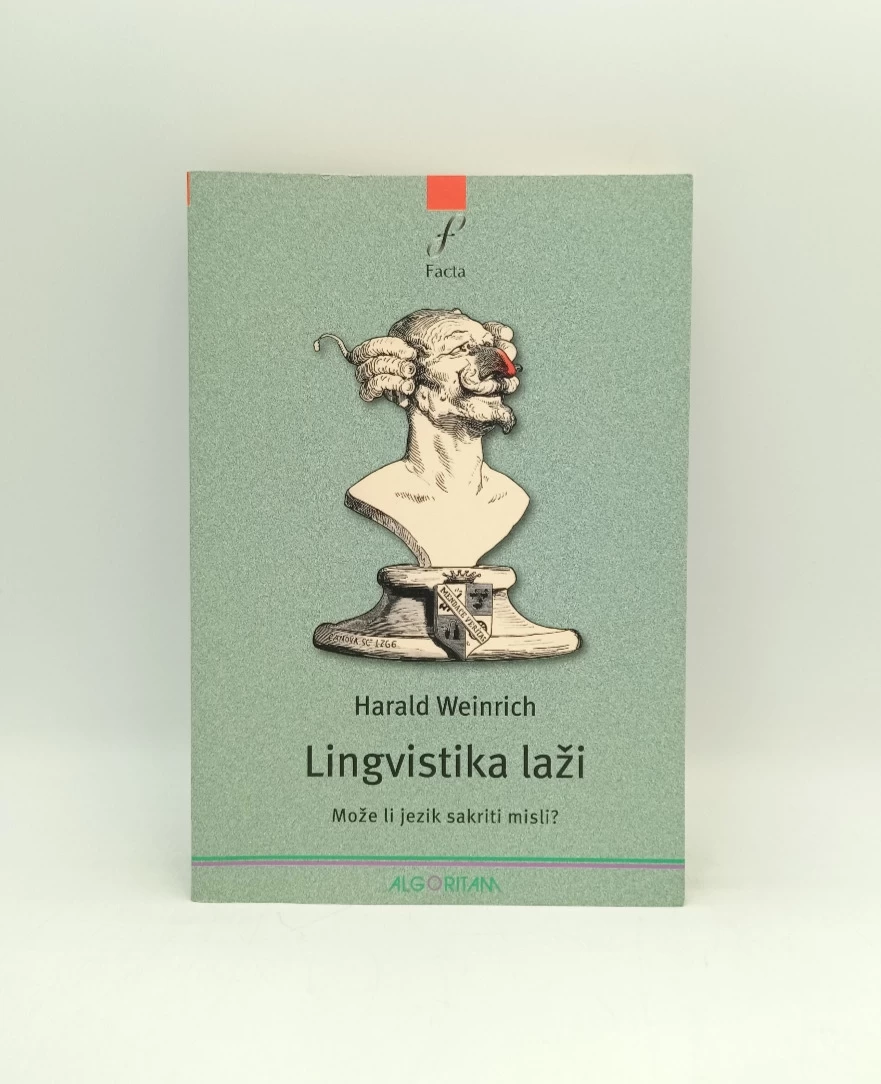
Lingvistika laži
Basic information
- Author: Weinrich Harald
- Publisher: Algoritam
- Availability: Available
- Condition: Excellent
- Code: 53509
Shipping options
Payment methods
Explore more
Lingvistika laži
Weinrich Harald
Summary
Harald Weinrich: The Linguistics of Lies
Can language hide thoughts?
"Your husband is dead and greets you," says Goethe's Mephisto to Mrs. Martha Schwerdtlein. That message from Mephis is a lie. Mephisto knows nothing about whether Schwerdtlein is dead, and in any case does not convey any of his greetings. Most lies are of that kind, in sentences. There is no doubt that one can lie with sentences, but can one also lie with words?" And Socrates, did he, by teaching us irony, teach us to lie? What do Dionysius Cato and Voltaire think about lies, and what do St. Augustine, Brecht and Herder think?
These are just some of the questions posed by Harald Weinrich, in his famous essay (or, in the words of the jury, in an "unusual and brilliant study") for which he received the first prize in 1965 in the contest "Can language hide thoughts?" of the German Academy of Language and Literature. Weinrich defends the "truthfulness of language" and at the same time does not dispute that there are words that have suffered abuse (democracy, Lebensraum, blood and soil...), but shows that their falsehood is closely related to the cultural and linguistic context, and that one who does not manage to lie among people will not be able to do so in literature.
Additional information
- Author: Weinrich Harald
- Publisher: Algoritam
- Year of publication:2005
- Place of publication:Zagreb
- Pages:79
- Dimensions:13x20 cm
- Script:Latin script
- Condition:Excellent
- Binding:Softcover
Reviews
0 reviewsWrite a review
Share your experience and help other readers choose.
This item has no reviews yet. Be the first to share your experience.
More books from Algoritam















You may also like










Recently viewed