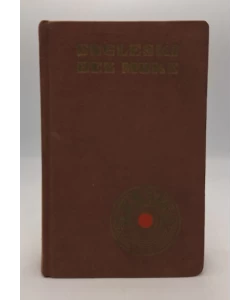

Fizika i metafizika
Basic information
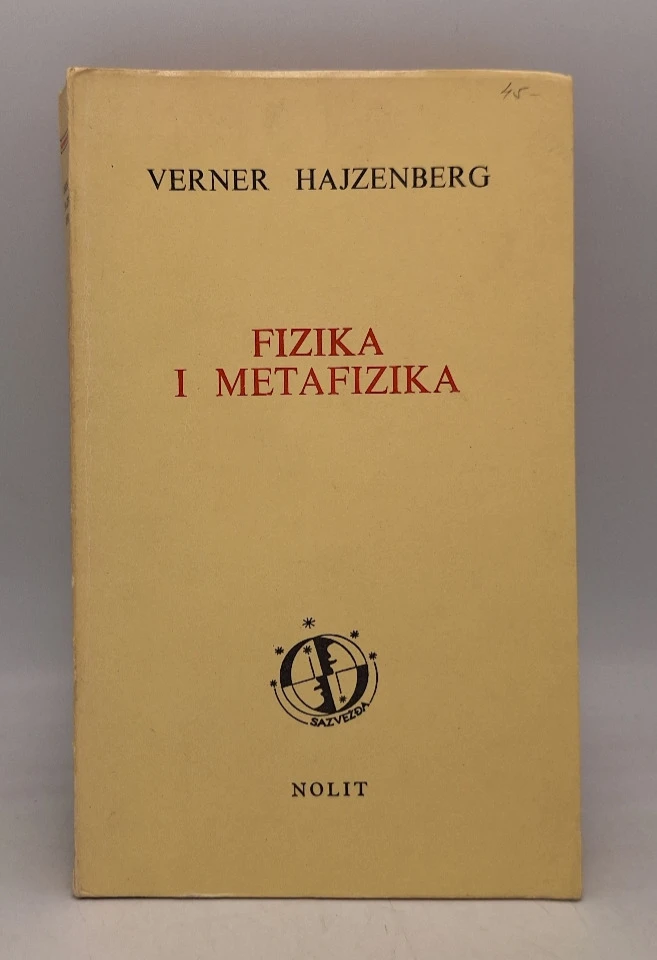
- Author: Heisenberg Werner
- Publisher: Nolit
- Availability: Sold out
- Condition: Very good
- Code: 22970
Shipping options
Payment methods
Explore more
Fizika i metafizika
Heisenberg Werner
Summary
Werner Heisenberg: Physics and Metaphysics
Heisenberg's intellectual biography was presented to our readers immediately after the celebration of the seventieth anniversary of his birth. Heisenberg was born in 1901 in Würzburg. He studied theoretical physics under Sommerfeld. He defended his doctoral dissertation in 1923 with a solution to a hydrodynamic problem that is still the subject of controversy today. He then joined the group around Niels Bohr, who created a center for theoretical studies of the newly discovered atomic dynamics in Copenhagen. He is one of the few who manages to give Bohr's imaginations a precise mathematical form. He formulated the so-called matrix mechanics (1925) and uncertainty relations (1927) which complete the search for internally consistent attitudes that are necessary and sufficient to describe the behavior of physical systems at microscopic levels. Today we call that circle non-relativistic quantum mechanics. He received the Nobel Prize in 1932. He participated in almost all the world meetings that dealt with the new scheme and asserted himself as its main protagonist alongside Bohra. In 1932, he formulated isotropic spin and continued to develop an interest in the phenomenon of symmetry. During the war, he stays in Germany and works on projects related to applied physics. It is about that circle of questions that are being solved in the USA by his colleagues who were exiled from Germany, from which nuclear weapons are being developed. In 1943, he returned to Wheeler's idea (1937), according to which all processes related to elementary particles should be described only by measurable quantities (so-called S-matrices). At the same time, he is interested in the nature of magnetism and cosmic radiation. In the 1960s, he published a series of papers on the structure of elementary particles. This time he is followed by a small number of researchers. He also wrote many philosophical treatises, the most important of which is the book Physics and Philosophy (1958). The book that is now in front of you is the spiritual confession of one of the most significant creators of modern ideas about the structure of the inorganic world. It considers a wide range of issues and has the characteristics of an original document. Even when the analyzes lose their persuasiveness, by reading it, we participate in the moment of the birth of a thought that is imbued with a constant longing to be its own and open.
Werner Heisenberg (1901 – 1976), winner of the Nobel Prize in Physics, was born in Würzberg, Germany, and received his doctorate in theoretical physics at the University of Munich. He became famous for his revolutionary discovery of the uncertainty principle. After World War II, he was appointed director of the Max Planck Institute for Physics and Astrophysics.
Additional information
- Author: Heisenberg Werner
- Publisher: Nolit
- Year of publication:1972
- Place of publication:Beograd
- Pages:367
- Dimensions:12x19 cm
- Script:Latin script
- Condition:Very good
- Binding:Softcover
Reviews
0 reviewsWrite a review
Share your experience and help other readers choose.
This item has no reviews yet. Be the first to share your experience.
More books by Heisenberg Werner

More books from Nolit