
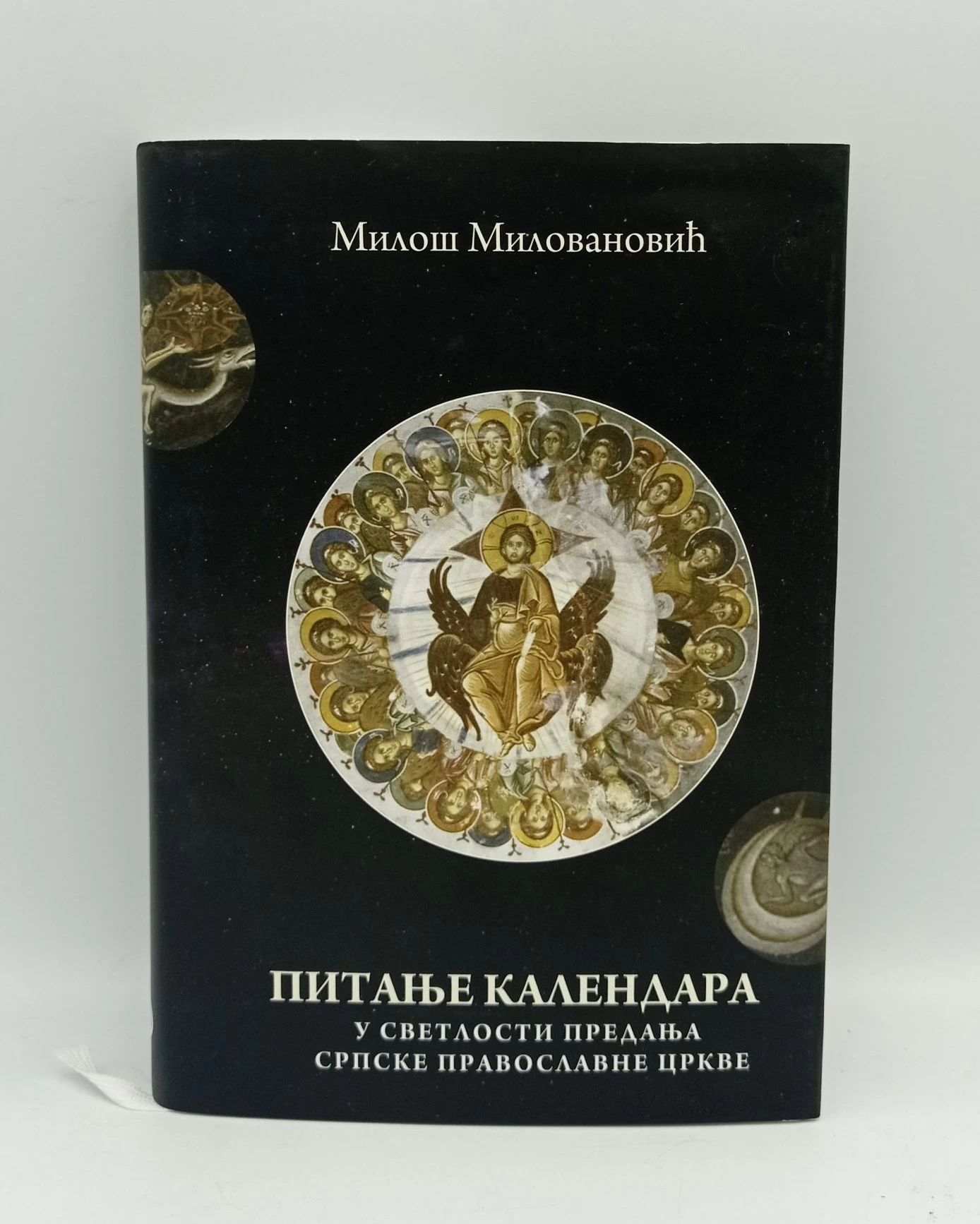
Pitanje kalendara u svetlosti predanja Srpske pravoslavne crkve
Basic information
- Author: Milovanović Miloš
- Publisher: Metaphysica
- Availability: Available
- Condition: New book
- Code: 62028
Shipping options
Payment methods
Explore more
Pitanje kalendara u svetlosti predanja Srpske pravoslavne crkve
Milovanović Miloš
Summary
Miloš Milovanović: The question of the calendar in the light of the traditions of the Serbian Orthodox Church When we face the question of the calendar, we are in doubt - where to start. Man and time are indeed inextricably linked to such an extent that the dilemma arises as to whether time is a human concept or man is temporal. Both are caught in an endless web of life and death. They got involved in it out of their free will or out of necessity - it doesn't really matter in which of those two ways. Time was not removed by Christ's resurrection, and we rightly believe that it will not be removed by the universal resurrection either [Berđaev, chapter 4; Cullmann, pages 45-50]. In the Church after Pentecost, time represents the experience of the holy mysteries, i.e. liturgical time whose archetype is eternity [Kalokyris]. It occurs in an intimate relationship with persons, expressing their aspiration to the Godhead, which the Holy Spirit witnesses with his presence [Loski, chapter 8]. The words from the Revelation of John [chapter 10, verse 6] that there will be no more time refer to the overcoming of mortality, but the significance of this term is not exhausted by this. The liturgical context represents the basis on which we build the considerations in this work. It unites numerous aspects that - whether they are scientific, historical or dogmatic-theological and cultural - are individually lost in the one-sidedness of the approach to the problem, the comprehensiveness of which ranks it among the most complex ever considered. Any attempt to limit the question of the calendar - inevitably leads to overlooking the phenomenon and reducing it to a conceptual framework that denies it its primordial significance. Liturgical awareness, however, was regularly absent in the consideration of the calendar question, which posed it as scientific, cultural, and even ideological or national, refusing to recognize its complex nature, which we consider a defining characteristic. Such a state of affairs resulted in the adoption of a new style, the bitter fruits of which we are daily witnesses. (R5)
Additional information
- Author: Milovanović Miloš
- Publisher: Metaphysica
- Year of publication:2021
- Place of publication:Beograd
- Pages:254
- Dimensions:15x21 cm
- Script:Cyrillic script
- Condition:New book
- Binding:Hardcover with dust jacket
Reviews
0 reviewsWrite a review
Share your experience and help other readers choose.
This item has no reviews yet. Be the first to share your experience.
More books from Metaphysica




You may also like








Recently viewed