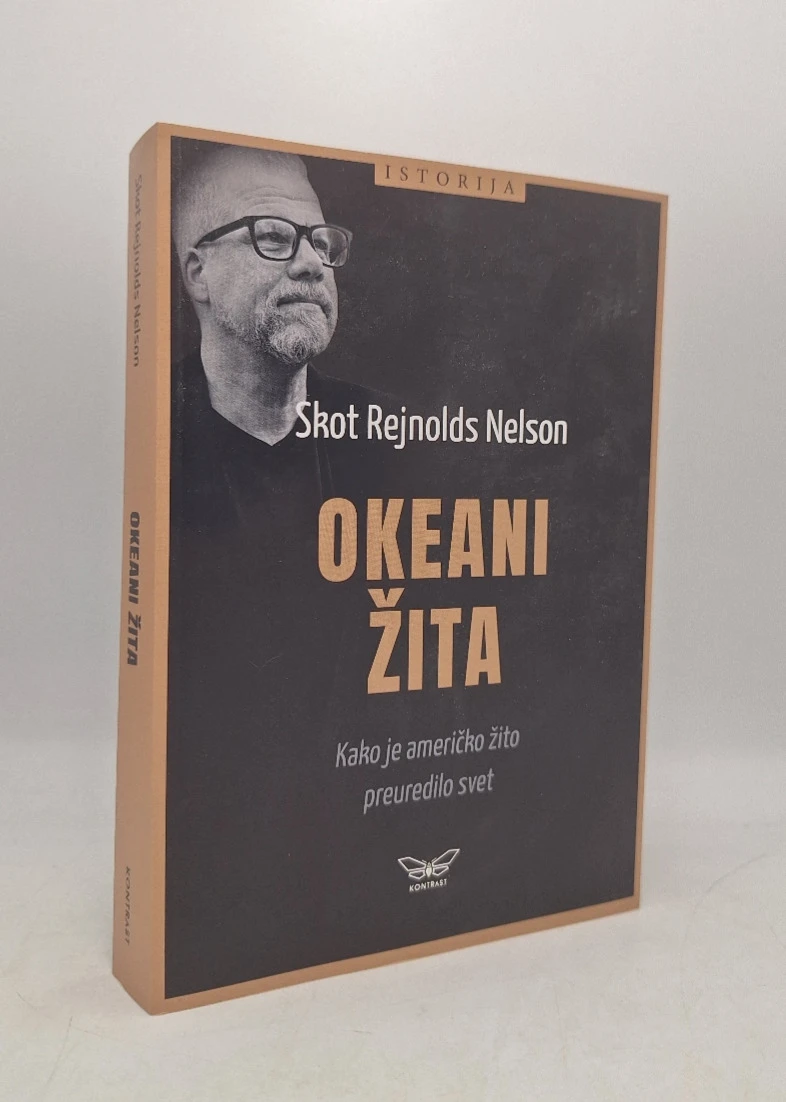
Okeani žita: Kako je američko žito preuredilo svet
Basic information
- Author: Reynolds Nelson Scott
- Publisher: Kontrast izdavaštvo
- ISBN: 9788660364311
- Availability: Available
- Condition: New book
- Code: 84754
Shipping options
Payment methods
Explore more
Okeani žita: Kako je američko žito preuredilo svet
Reynolds Nelson Scott
Summary
Scott Reynolds Nelson: Oceans of Grain: How American Grain Reshaped the World
"Oceans of Grain: How American Grain Reshaped the World" by Scott Reynolds Nelson is a monumental work that reconstructs global history through the prism of the grain trade from ancient times to the early 20th century. Nelson expands the historiography beyond the usual political narratives and offers a radical interpretation: the grain trade, not political ideologies or military campaigns, created, sustained and destroyed empires for centuries. This ambitious thesis spans more than 350 pages of text, bringing together economic history, political economy, microbiology, technological history, and geopolitics in a synthesis of rarely seen depth and scope. The book begins with the "black tracks" - trade routes as old as civilization itself. Chumacs, traders who transported grain across the Eurasian steppes by oxen, represent Nelson's metaphor for the durability of trade networks that preceded formal states. Ancient empires—from Athens to Byzantium—actually rode on existing trade routes rather than creating them. This insight overturned the traditional narrative of emperors as civilizers: empires, Nelson argued, were parasites on trade rather than its creators. By tracking the mutations of the bacterium Yersinia pestis, the causative agent of the plague, the author shows that trade routes existed thousands of years before written sources. Constantinople/Istanbul plays a central role as a key point of control between the Black Sea and the Mediterranean. The city that controls the Bosphorus controls access to Ukrainian granaries and thus the food of European cities. Nelson masterfully reconstructs how, at the end of the 18th century, the Russian empress Catherine II, inspired by physiocratic theories, devised an empire model based on the export of grain. With the founding of Odessa in 1794, Russia became the first global grain exporter, reshaping the power hierarchy in Europe. This transformation required a system that turned serfdom into something closer to slavery, in order to maximize the production of wheat for export.
Additional information
- Author: Reynolds Nelson Scott
- Publisher: Kontrast izdavaštvo
- Year of publication:2026
- Place of publication:Beograd
- Pages:366
- Dimensions:14x20 cm
- Script:Latin script
- Condition:New book
- Binding:Softcover
Reviews
0 reviewsWrite a review
Share your experience and help other readers choose.
This item has no reviews yet. Be the first to share your experience.
More books from Kontrast izdavaštvo












You may also like