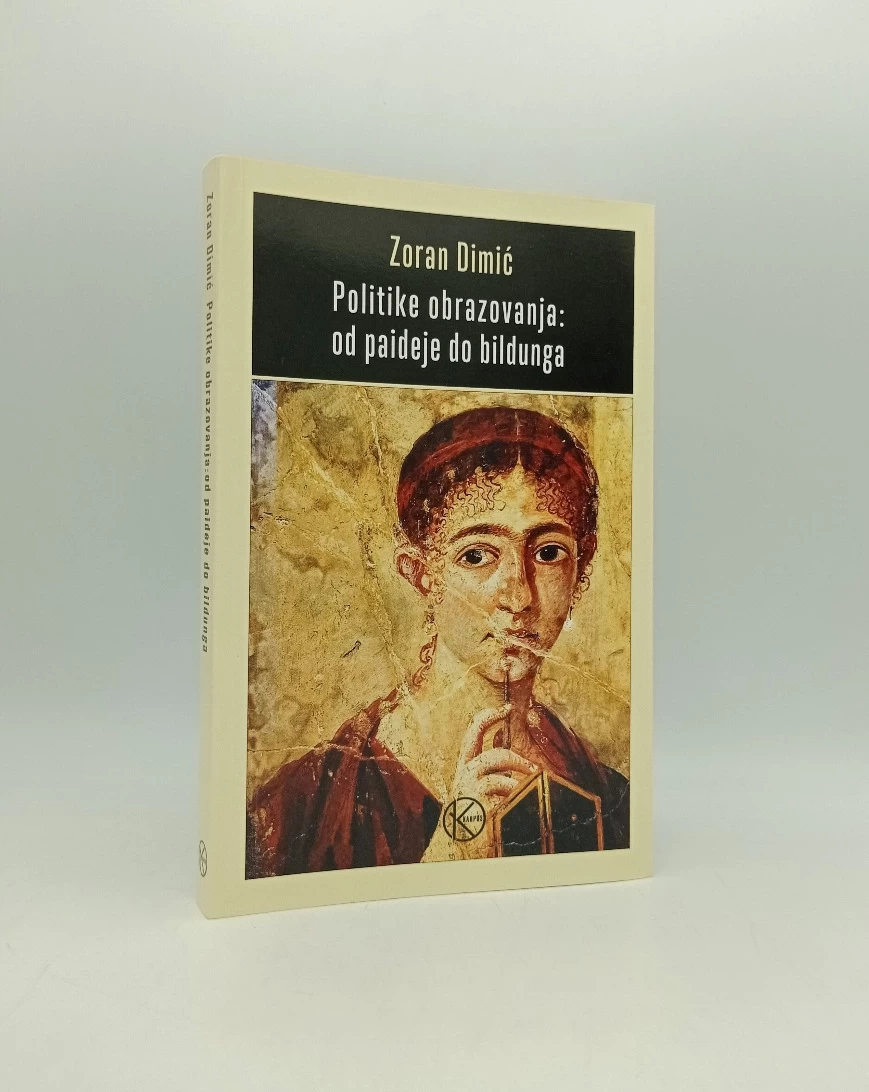

Dimić Zoran: Politike obrazovanja: od paideje do bildunga
€ 10,00
Free delivery in Croatia for orders over EUR 70
Basic information
- Author: Dimić Zoran
- Publisher: Karpos
- Availability: Available
- Condition: Nova knjiga
- Code: 69979
Shipping options
GLS Croatia
5€
Delivery
0€
Personal collection at the antique store
0€
GLS parcel machine
3€
Payment methods
Pay on pickup
CorvusPay
By general payment / Virman / Internet banking
Cash on delivery
Politike obrazovanja: od paideje do bildunga
Dimić Zoran
Summary
Zoran Dimić: Education policies: from paideia to bildung
A more detailed study of ancient texts on paideia quickly reveals to us how closely this topic was connected with the original meaning of politics, which in antiquity was undoubtedly the topic of all topics, both for the citizens of the ancient polis and for the citizens of the ancient polis. for philosophers. The meaning and goal of the ancient Greek concept of upbringing and education should therefore be seen in the context of the efforts and wishes of the members of the political community to improve their common life. Ignoring the real historical context in which the concept of paideia was born and developed, where its political origin is obvious, often led to its romanticization and misinterpretation, which neglected upbringing and education as an object of mutual strategic manipulation of civil groups and individuals.
Although in the centuries after the disappearance of the ancient world, and especially in the Middle Ages, interest in educational topics declined, the modern era reintroduced educational topics into the civil world. It was this moment that became very important for the identity of what we call the modern world. Solving educational problems becomes of crucial importance for the formation of what Kant called the "world civil order".
Educational policies: from paideja to bildung prof. Zoran Dimić, follows the conceptualization of educational issues from antiquity to modern times, focusing especially on Aristotle, Humboldt, Fichte, Dewey. The book contains seven different studies, created in the period from 2000 to 2010, whose common denominator is the description and interpretation of the constant tension between the individual and his political community, which represents by far one of the most fateful dramas of Western culture and civilization. .
Additional information
- Author: Dimić Zoran
- Publisher: Karpos
- Year of publication:2017
- Place of publication:Beograd
- Pages:187
- Dimensions:13.5x20.5 cm
- Script:Latinica
- Condition:Nova knjiga
- Binding:Meki
You may also like






Recently viewed









Biblos Newsletter
For book lovers who enjoy finding the rare
New titles, special copies and quiet recommendations from the antiquarian bookshop.