
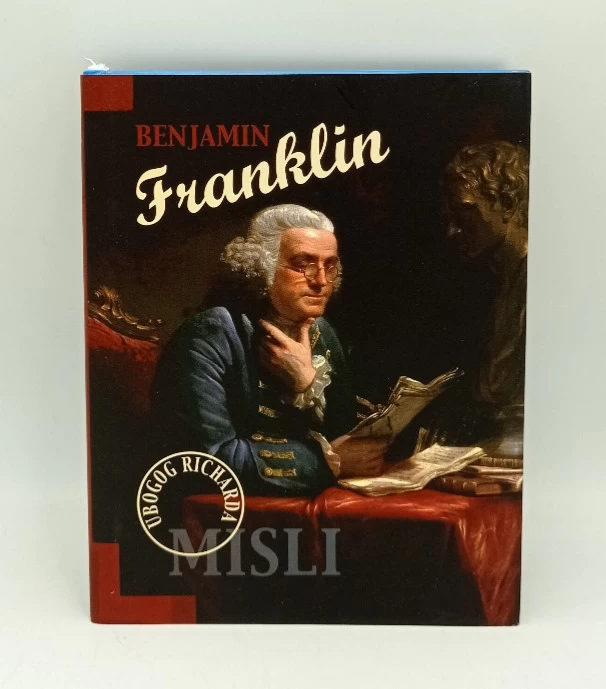
Misli ubogog Richarda
Basic information
- Author: Franklin Benjamin
- Publisher: Šareni dućan
- Availability: Available
- Condition: Very good
- Code: 56674
Shipping options
Payment methods
Explore more
Misli ubogog Richarda
Franklin Benjamin
Summary
Benjamin Franklin: Thoughts of Poor Richard
Benjamin Franklin (1706-1790), statesman, diplomat and scientist, is certainly one of the most famous and well-known Americans of the 18th century. He is a multi-faceted person who is praised by many as a kind of guru of progress, while others accuse him of paving the way for some less attractive aspects of modern capitalism with his "Protestant ethic". is a negotiator in the English withdrawal and one of the creators of the American Constitution, which is still today, after more than two hundred years, a fundamental American legal act.
Apart from politics, perhaps even more important to him is broad social action. He was the founder and long-time head of the US Postal Service, and he was particularly interested in various forms of targeted action by the human community, so he devised, initiated and organized the functioning of some important institutions: the fire service, the lending library, the insurance company, the public university and the public hospital. today almost a trademark - a "brand"), he also constructed the first "sparet" (the so-called Franklin's economical stove), bifocal glasses, he dealt with electricity (he determined and - charges, explained the fact of grounding), the theory of light, came up with numerous innovations in navigation and navigation... He was a member of the world's most prestigious scientific societies and academies at the time and one of the most prominent freemasons of his time.
And yet, the favorite way he could present himself was: »Benjamin Franklin, printer.« He was an excellent typewriter and printer, known and respected from an early age for his special printing skills, but also as the owner of numerous printers across America, in Jamaica and Antigua, and in later life in France. He was also a publisher: owner and editor of the influential newspaper The Pennsylvania Gazette (1729–65), author and publisher of the popular and highly circulated Poor Richard's Almanack (1732–57), and published numerous books by American, English, French, and German authors. religious themes, and he was particularly known (under the strong influence of Swift) for political-satirical travesties and "ducks" about current events. Balzac wrote that "Franklin invented the lightning rod, the political 'duck' (le canard) and the republic". With literary pretensions, he wrote Autobiography (1771-88), considered by many to be one of the best works of its kind. For years he worked on the Art of Virtue; he did not complete it, and the manuscript was not published.
"An occasional or periodical publication with appendices of various contents" - an almanac (or, sometimes, a yearbook) appeared in the 13th century as a kind of calendar and astronomical manual, which over time (after the 16th and 17th centuries) turned into popular reading, especially in England and Germany. Later, only at the beginning of the 19th century, almanacs will also appear in Croatia (the most famous and longest-lived is "Danica"), as yearbooks, calendars and collections of instructive, mostly economic and agricultural articles, biographies, proverbs and riddles, with a few literary contributions. They often used to be the only secular reading that would be read in the family during the year, so the compilers of almanacs had to be both educators and moralizers and entertainers. And if they were also promiscuous like Franklin, they could have made good money from it. This is how he himself briefly refers to the Almanac in his Autobiography:
»In 1732 I published my almanac, under the name of Richard Saunders; I continued to publish it for the next twenty-five years under the pop
with the title Poor Richard's Almanack. I tried to make it both fun and useful, so in accordance with such an intention, I made quite a bit of money on it, selling almost ten thousand copies a year. Observing that it was read by many, and that scarcely a community in the province was without it, I used it as a suitable means of spreading instruction among the common people, who hardly bought any other books; therefore, I filled all the small gaps between individual days in the calendar with proverbial sentences, mostly those that inculcated diligence and moderation as the paths to acquiring wealth and preserving virtues; it is much more difficult for a man in trouble to always be honest, just as - to use one of those proverbs - an empty sack will hardly stand upright.
I collected these proverbs, which contain the wisdom of many centuries and peoples, and from them formed a connected edition added to the Almanac from 1757, as an address of an old sage to the people gathered at the auction. All these scattered instructions, gathered now in focus, could have caused more attention. This reading was widely accepted and reprinted in all the newspapers of the entire continent. It was widely reprinted in Britain and kept in homes; two translations were published in French, it was mostly bought by the clergy and nobility, to be distributed free of charge to poor parishioners and tenants. As for Pennsylvania, since that work advocated against unnecessary spending on foreign trinkets, some believe that it had some influence on the increase in the amount of money, which could be seen in the few years after its publication. He is a multi-faceted person who is praised by many as a kind of guru of progress, while others accuse him of paving the way for some less attractive aspects of modern capitalism with his "Protestant ethic". is a negotiator in the English withdrawal and one of the creators of the American Constitution, which is still today, after more than two hundred years, a fundamental American legal act.
Apart from politics, perhaps even more important to him is broad social action. He was the founder and long-time head of the US Postal Service, and he was particularly interested in various forms of targeted action by the human community, so he devised, initiated and organized the functioning of some important institutions: the fire service, the lending library, the insurance company, the public university and the public hospital. today almost a trademark - a "brand"), he also constructed the first "sparet" (the so-called Franklin's economical stove), bifocal glasses, he dealt with electricity (he determined and - charges, explained the fact of grounding), the theory of light, came up with numerous innovations in navigation and navigation... He was a member of the world's most prestigious scientific societies and academies at the time and one of the most prominent freemasons of his time.
And yet, the favorite way he could present himself was: »Benjamin Franklin, printer.« He was an excellent typewriter and printer, known and respected from an early age for his special printing skills, but also as the owner of numerous printers across America, in Jamaica and Antigua, and in later life in France. He was also a publisher: owner and editor of the influential newspaper The Pennsylvania Gazette (1729–65), author and publisher of the popular and highly circulated Poor Richard's Almanack (1732–57), and published numerous books by American, English, French, and German authors.
In his authorship
, his rich writing oeuvre includes numerous smaller or larger works, booklets and brochures with political, economic (financial), social and religious topics, and he was particularly known (under the strong influence of Swift) for political-satirical travesties and "ducks" about current events. Balzac wrote that "Franklin invented the lightning rod, the political 'duck' (le canard) and the republic". With literary pretensions, he wrote Autobiography (1771-88), considered by many to be one of the best works of its kind. For years he worked on the Art of Virtue; he did not complete it, and the manuscript was not published.
"An occasional or periodical publication with appendices of various contents" - an almanac (or, sometimes, a yearbook) appeared in the 13th century as a kind of calendar and astronomical manual, which over time (after the 16th and 17th centuries) turned into popular reading, especially in England and Germany. Later, only at the beginning of the 19th century, almanacs will also appear in Croatia (the most famous and longest-lived is "Danica"), as yearbooks, calendars and collections of instructive, mostly economic and agricultural articles, biographies, proverbs and riddles, with a few literary contributions. They often used to be the only secular reading that would be read in the family during the year, so the compilers of almanacs had to be both educators and moralizers and entertainers. And if they were also promiscuous like Franklin, they could have made good money from it. This is how he himself briefly refers to the Almanac in his Autobiography:
»In 1732 I published my almanac, under the name of Richard Saunders; I continued to publish it for the next twenty-five years under the popular title of Poor Richard's Almanack. I tried to make it both fun and useful, so in accordance with such an intention, I made quite a bit of money on it, selling almost ten thousand copies a year. Observing that it was read by many, and that scarcely a community in the province was without it, I used it as a suitable means of spreading instruction among the common people, who hardly bought any other books; therefore, I filled all the small gaps between individual days in the calendar with proverbial sentences, mostly those that inculcated diligence and moderation as the paths to acquiring wealth and preserving virtues; it is much more difficult for a man in trouble to always be honest, just as - to use one of those proverbs - an empty sack will hardly stand upright.
I collected these proverbs, which contain the wisdom of many centuries and peoples, and from them formed a connected edition added to the Almanac from 1757, as an address of an old sage to the people gathered at the auction. All these scattered instructions, gathered now in focus, could have caused more attention. This reading was widely accepted and reprinted in all the newspapers of the entire continent. It was widely reprinted in Britain and kept in homes; two translations were published in French, it was mostly bought by the clergy and nobility, to be distributed free of charge to poor parishioners and tenants. As for Pennsylvania, since that work advocated against unnecessary spending on foreign trinkets, some hold that it had some effect on the increase in the amount of money, which was noticeable in the few years after its publication. They have already become almost universal, like timeless folk proverbs. Simply, they are there as something that exists by itself. In the same way, people are surprised to learn that it was necessary to "invent" firemen or "sparets", because they believe that this also arose by itself, as a consequence of general common sense. But it didn't: it was established, organized and then promoted by the shrewd practitioner Ben Franklin, who graduated from the public school.
And although poor Richard's deliberations show everyday cleverness and popular shrewdness, but often also narrow-minded, philistine cunning, in Franklin's political and social writings (and
action) there is no trace of that narrow pettiness suggested by Richard's life prescriptions. He was not only an advocate of his state (Pennsylvania), nor of a wider region, but (long before the War of Independence) he wanted the American Union as a whole. He noted the importance of demography and demanded that land grants be regulated. He spent two decades in London and Paris in delicate diplomatic missions, trying to tie France to America so that it could more easily break away from the heavy British colonial grip. In Europe (especially in Paris), he was worshiped as the embodiment of the Enlightenment, and the fur cap he often wore gave him the halo of a "noble savage". He was of "good material" (his parents also died at a late age), he lived moderately (more in drinking than in eating), he was an enthusiastic swimmer, a "believer" of cool, fresh air (he devotedly preached the "gospel of airing"). Charming goat, slightly sarcastic, often used anecdotes as an argument. He had two illegitimate children (before marriage), then a marriage to the industrious and frugal but rather boring Deborah Reed, illiterate and decidedly uninterested in science and literature. Although often accused of expressing undisguised misogynistic attitudes in his songs and especially in his poems, Franklin was very happy to indulge in the company of women, so in his 16-year-old widowhood he maintained relationships with several women, and his last years - to the dismay of the Puritans - were brightened by the young Mme Brillon, who "taught and corrected" him French and converted him to Catholicism.
He came from a strict Protestant (Puritan) family. families. After the age of 20, he stopped going to church and lived as a moderate believer with the motto of the 13th virtue: "Imitate yourself to Jesus and Socrates."
And in everyday life he adhered to his 13 virtues (see them on p. 106-107), so he always had a notebook with him (he called it the art of virtue), in which, like a merchant, he wrote weekly, monthly and yearly adherence and numerical fulfillment certain virtues.
Convinced that God is the source of wisdom, he believed that in order to achieve virtues one should persistently turn to Him, so he came up with his own, daily prayer:
»O mighty Goodness! Generous Father! Merciful Counsellor! Encourage in me the wisdom that will reveal to me the truest gains. Strengthen my resolve to do what this wisdom requires. Accept my most sincere favors and all Your other fruits, as just a small thank you with which I am able to repay Your unceasing graces that You give me."
Without a doubt, Benjamin Franklin was prone to excessive introspection, and his great interest in teaching others is expressed precisely in the maxims of poor Richard. Often too utilitarian, they were very successful in creating traditional American and then Western "morality".
Additional information
- Author: Franklin Benjamin
- Publisher: Šareni dućan
- Year of publication:2012
- Place of publication:Koprivnica
- Pages:148
- Dimensions:12x15 cm
- Script:Latin script
- Condition:Very good
- Binding:Hardcover with dust jacket
Reviews
0 reviewsWrite a review
Share your experience and help other readers choose.
This item has no reviews yet. Be the first to share your experience.
More books from Šareni dućan












You may also like











Recently viewed