
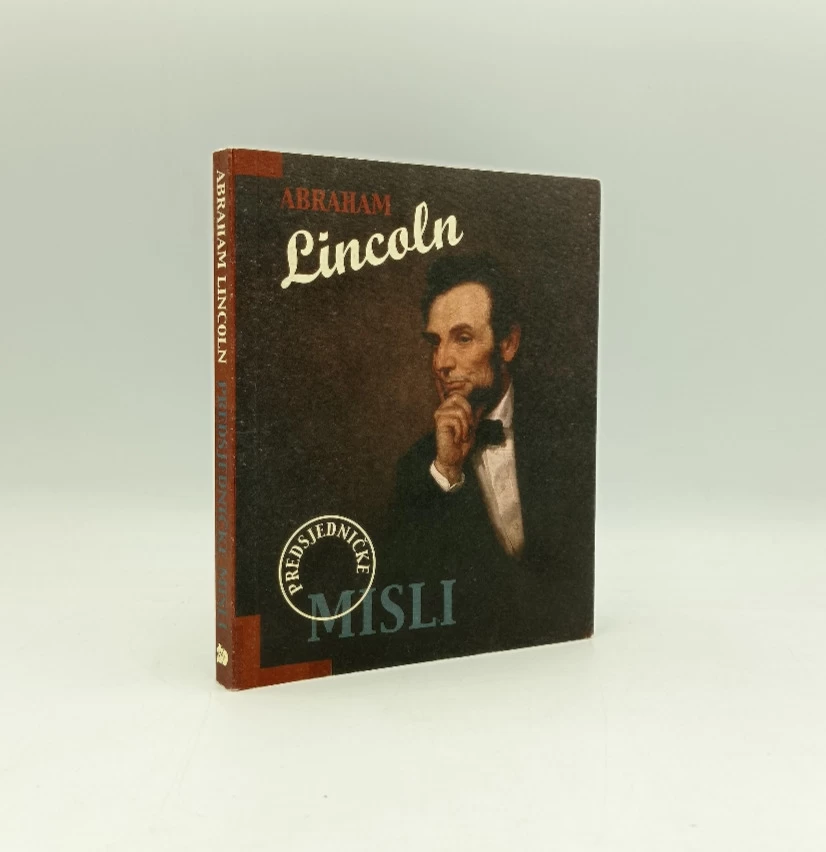
Predsjedničke misli
Basic information
- Author: Lincoln Abraham
- Publisher: Šareni dućan
- Availability: Available
- Condition: Excellent
- Code: 44418
Shipping options
Payment methods
Explore more
Predsjedničke misli
Lincoln Abraham
Summary
Abraham Lincoln: Presidential Thoughts
Ordinary-looking people are the best in the world,
that is why God creates so many of them.
You can fool some people all the time and all the people some of the time, but you cannot fool all the people all the time.
He who does not want to be a slave must come to terms with
that he cannot own slaves himself.
If you like both conflicting sides deny,
this probably means that you are right.
Beware when one side attacks you and the other praises you.
Mythical figure and monumental thoughts
The mythical reputation that Abraham Lincoln enjoys in the American collective consciousness is exactly as great as the ignorance of facts from Lincoln's life in Europe, and especially in Croatia. Steven Spielberg's great biographical spectacle will certainly help in correcting these "holes in knowledge", and in a different, certainly deeper and more lasting way, this conveniently designed booklet of Lincoln's thoughts and thoughts about Lincoln. comic...
Lincoln for the United States is not (only) what Garibaldi is for Italy, Napoleon for France or Atatürk for Turkey: Lincoln is for Americans a much bigger figure. This is best reflected in the poems included in this book, which are signed by the true classics of American (and world) literature, Walt Whitman and Herman Melville. For Whitman, Lincoln is the unquestionable leader, the "captain" of the nation who tragically dies after, after an epic journey, he has already brought the ship to a safe harbor. Melville goes much further: linking to the fact that Lincoln was killed on Good Friday (the symbolism is even more emphasized in our translation: The Passion of God was that day), the author of Moby Dick, his hero, a "martyr", which because of his merits and virtues (primarily the virtue of forgiveness), which because of the treacherous hand by which he suffered, openly compares it to Jesus himself.
Furthermore, let's recall the monumentality of the Lincoln Memorial in Washington, huge of the neoclassical monument, that new-age Parthenon, or rather: the Pantheon, in which the titanic president's stone figure sits - one, unique and above all - just like Zeus on Olympus. Therefore, it is not unusual that of all the four great presidents whose figures are carved on Mount Rushmore (the other three are Washington, Jefferson and Roosevelt), only Lincoln had a separate monument of comparable proportions, and that in the city that bears the name of George Washington, and in which - there is no similar monument to Washington. It is the ultimate testimony of Lincoln's significance to US history. But not only that: the strength that emanates from that monument is also connected to one of Lincoln's numerous characteristics with which we outside the USA (were) poorly familiar, and which for Americans represent "common places". Although his black and white photos may not give that impression, Lincoln was considered one of the most physically powerful men of his time. It is therefore amusing to recognize when in films the physical strength of a character is compared not to, say, Hercules, but to Lincoln's, and which context remains unclear if we do not know the given information.
When we mention films, we should briefly dwell on The Crossing Guard (The Crossing Guard) by director Sean Penn from 1995, in which Jack Nicholson intends to kill David Morse in order to take revenge on him for hiding the death of his daughter while driving drunk. The character played by David Morse in the film is called John Booth, actually the same as Lincoln's assassin John Wilkes Booth. This reference (although the film develops in significantly different directions and implications) clearly indicates: John Wilkes Booth, the assassin of Lincoln, is synonymous with the assassin, he is the Assassin with a capital letter (and not, for example, Lee Harvey Oswald, the assassin, or alleged assassin, of that also mythical "young king" John F
. Kennedy). If Booth is synonymous with the Murderer and Judas, then it is logical why Lincoln is synonymous with the Righteous One, and vice versa.
Such allusions are not unusual if we know that stories and legends were written about Lincoln's life, such as were experienced perhaps only (in truth, in different, even more malignant contexts) by Lenin, Stalin, Mao and Tito, and in recent times, probably only by the North Korean "Kims" and various "Turkmenbas", wherever they were. However, unlike the aforementioned, whose legendary status lasted (or will last) more or less as long as the systems with which we associate them, Lincoln seems to resist attempts at historical revaluation, just as the superpower he built, almost a century and a half after his death, resists all historical temptations to diminish its own role in the world. we will find it easiest by reading these thoughts of his. These are true proofs of Lincoln's true greatness, proofs that resist any mythologizing precisely because they don't even need mythologizing, because they are timeless and always current. Lincoln's thoughts represent the basis of modern democracy, the understanding of freedom and the idea of equality for all people, regardless of racial and other differences.
Some of these thoughts - for example: "The desire to work is such a rare virtue that it should be encouraged" - will certainly seem so relevant to the Croatian reader that it will also provoke an unrestrained smile, probably with a bitter undertone, which is not unusual in a country that may have experienced its Washington, but unfortunately not yet its Lincoln, and when will it? one does not know.
Denis Peričić
Additional information
- Author: Lincoln Abraham
- Publisher: Šareni dućan
- Year of publication:2013
- Place of publication:Koprivnica
- Pages:108
- Dimensions:12x15 cm
- Script:Latin script
- Condition:Excellent
- Binding:Softcover
Reviews
0 reviewsWrite a review
Share your experience and help other readers choose.
This item has no reviews yet. Be the first to share your experience.
More books from Šareni dućan



You may also like




Recently viewed