Specimen de fortuna latinitatis
Basic information
- Author: Galjuf Marko Faustin
- Publisher: Favale
- Availability: Available
- Condition: Very good
- Code: 20386
Shipping options
Payment methods
Explore more
Specimen de fortuna latinitatis
Galjuf Marko Faustin
Summary
Marko Fustin Galjuf: Specimen de fortuna latinitatis
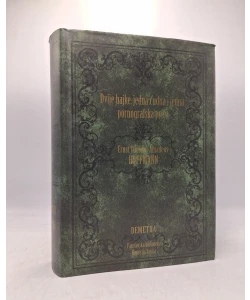
Specimen de fortuna latinitatis accedvnt poemata varia meditata et extemporalia
GALJUF, Marko Faustin (Gagliuffius, Marcus Faustinus; Gagliuffi), Latinist, poet (Dubrovnik, 15. II. 1765 — Novi Ligure, 16. II. 1834). He is a descendant of the Ivanović merchant family from Dubrovnik, for whom the form Galjuf (Italian: gaglioffo – gorse) was only a nickname at the end of the 16th century. In one epigram, G. says that he is from Dubrovnik by fate, Italian by life, and Latin by language ("Sorte Ragusinus, vita Italus, ore Latinus"). He began his education as a Piarist in his hometown, studied theology in 1780–85. at their college Collegium Nazarenum in Rome. He was a teacher of rhetoric in Piarist schools in Urbino (1785–87) and Rome (until 1797) and private scribe of Pope Pius VI. In February 1798, on the eve of the French occupation of Rome, he joined the Roman commoners who demanded that the papal authority be replaced by a secular one. When the Roman Republic was proclaimed in March 1798, G. took off his monk's robe and put himself in the service of the newly established government as its advocate and promoter. After the collapse of the Republic in September 1799, he took refuge in Genoa, then he was in the service of the Genoese legation in Paris, where he began studying law. Year In 1803, he was back in Genoa, working as a university librarian and professor of rhetoric, and after completing his law studies in 1805, he took over the chair of civil law at the Faculty of Law. When, after Napoleon's fall in 1814, Genoa was annexed to Piedmont, a fervent Bonapartist until then, G. became a supporter of restoration and papism. After he was removed from his position as professor and librarian in 1815, he traveled through Italy, Switzerland, France and Bavaria, living on the support of his patrons, whom he delighted with appropriate verses and virtuoso Latin improvisations, both original and translations from Italian. Year In 1831, he was reinstated as university librarian in Genoa. The excellent Latin improviser came to prominence in 1792 as a member of the Roman Academy of Arcadia (he has been a member since 1784 under the name Chelintus Epiroticus), in whose magazine Giornale Arcadico several of Galjuf's poems were published. G. calls his improvised songs (there are more than 500 of them) carmina extemporalia. He calls the second type, also predominantly occasional poems, carmina meditata (thought-out, thoroughly crafted poems), among which the most poetically refined and in the cultural-historical sense the most valuable poem (G. calls it an idyll) Navis Ragusina (Dubrovački brod), written on the occasion of the launch of the new trading ship of the Senčić brothers. Very impressive are the descriptions of the port of Gruja in that song and the ravishing evocations of some famous people from Dubrovnik: B. Zamanje (Đamanjić), B. Stay, R. Kunić, R. J. Bošković, Đ. Baglivij and M. Getaldić. It was first published, together with other Croatian, Latin and Italian poems composed for the occasion, in 1819 in Italy by I. A. Kaznačić, and in the same year the poet himself published it with a comparative Italian translation by Lazar Papi and again in the collection Specimen de fortuna Latinitatis. Accedunt Poemata varia meditata et extemporalia from 1833. In that collection, published in Turin a year before his death, G. included a rich selection of his improvised poems from previous printed and manuscript collections. As the title suggests, at the head of the collection is Galjuf's essay on the fate of the Latin language, Specimen de fortuna Latinitatis, a great essay on the beauty and expressiveness of the Latin language and its advantage over modern languages. Pietas domestica (1819) and Philothea pronuba (1820) stand out among commemorative works, and for Dubrovnik's cultural history, the one composed on the death of R. Kunić, dedicated to B. Stay (Benedicto Stay, ... Elegiam in Raymundum Cunichium, Rome 1795) is interesting. G. became famous, especially in Genoa, with numerous (about 200) Latin inscriptions, which were published by his student G. A. Scazzola in 1837 under the title Inscriptiones. From several speeches, which he gave in Rome and Genovi as a professor and even as a people's tribune during the Roman Republic, a few of them have been preserved.
ex libris Ivo Dubravčić
Additional information
- Author: Galjuf Marko Faustin
- Publisher: Favale
- Year of publication:1833
- Place of publication:Torino
- Pages:200
- Dimensions:14.5x22 cm
- Script:Latin script
- Condition:Very good
- Binding:Hardcover
Reviews
0 reviewsWrite a review
Share your experience and help other readers choose.
This item has no reviews yet. Be the first to share your experience.
You may also like