
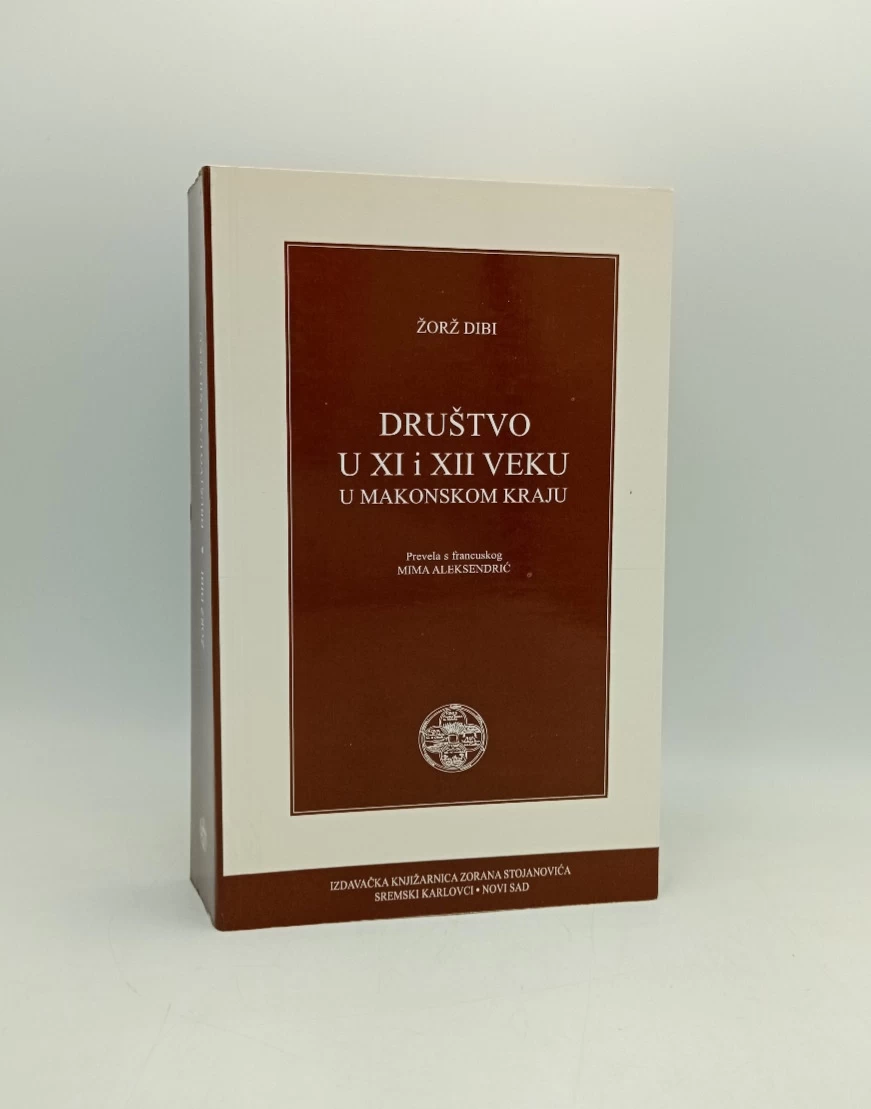
Društvo u XI i XII veku u makonskom kraju
Basic information
- Author: Duby Georges
- Publisher: Izdavačka knjižarnica Zorana Stojanovića
- Availability: Available
- Condition: New book
- Code: 42942
Shipping options
Payment methods
Explore more
Društvo u XI i XII veku u makonskom kraju
Duby Georges
Summary
Georges Duby: Society in the 11th and 12th centuries in the Macon area
Wanting to study society, especially lay society, during two important centuries of feudalism, I deliberately conducted research within the narrow framework of a small area. Namely, the method of regional monographs enables direct access to people, without separating them from their environment, enables to closely follow the history of families and possessions, to study different activities and institutions at the same time and to see the connections between them. Only this method can be a preparation for great syntheses, and it is known what progress it has already brought to France in geography and, in the field of medieval studies, in the history of political principalities or cities. Recent works in the field of social history encouraged me to apply it, so I tried to revive the entire population of an area in the 11th and 12th centuries, nobles and clergy, peasants and merchants. I chose the Macon region because the important work of the late Deleuze on rural life in Burgundy before the 11th century provided a solid starting point and greatly facilitated previous research. Another reason for this choice is that in the Macon region, the historian of feudal society has the extremely rare advantage of using cartulary from the 10th century and, accordingly, getting to know the ancestors of the people and the previous forms of the institutions he is studying. I did not want to precisely limit the area of my research in advance. Namely, neither the climate, nor the soil, nor the appearance of human habitations - anything outlines clear borders around the current Macon region; in Burgundy, Bressa, the Lyon region, the regions near the Loire pass through almost imperceptible changes. And as for the former frameworks of political geography, they seemed to me as arbitrary as today's.
Additional information
- Author: Duby Georges
- Publisher: Izdavačka knjižarnica Zorana S...
- Year of publication:2011
- Place of publication:Sremski Karlovci
- Pages:662
- Dimensions:14x22.5 cm
- Script:Latin script
- Condition:New book
- Binding:Softcover
Reviews
0 reviewsWrite a review
Share your experience and help other readers choose.
This item has no reviews yet. Be the first to share your experience.
More books by Duby Georges
More books from Izdavačka knjižarnica Zorana Stojanovića






You may also like








Recently viewed