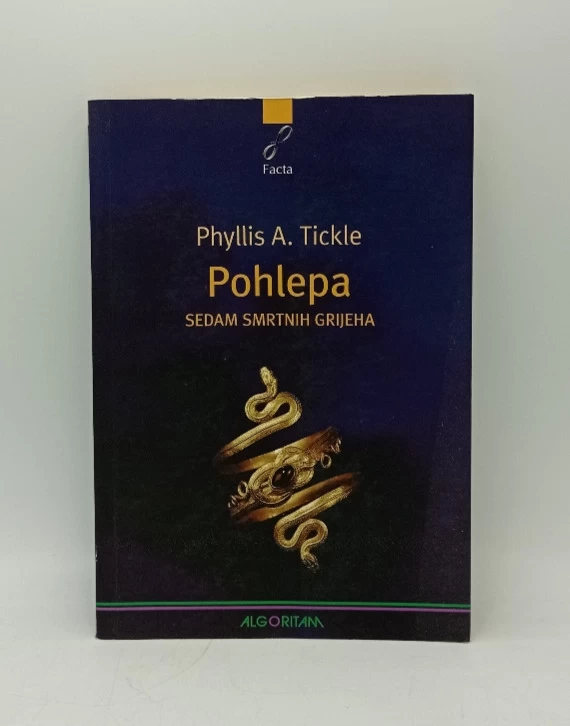

Tickle Phyllis: Pohlepa
€ 5,50
Free delivery in Croatia for orders over EUR 70
Basic information
- Author: Tickle Phyllis
- Publisher: Algoritam
- Availability: Available
- Condition: Odlično
- Code: 52698
Shipping options
GLS Croatia
5€
Delivery
0€
Personal collection at the antique store
0€
GLS parcel machine
3€
Payment methods
Pay on pickup
CorvusPay
By general payment / Virman / Internet banking
Cash on delivery
Pohlepa
Tickle Phyllis
Summary
Phyllis Tickle: Greed
The Seven Deadly Sins
For nearly fifteen years, The New York Public Library and Oxford University Press have invited prominent figures in the fields of social science and literature to deliver a series of lectures on a topic of their choice. These two institutions asked seven distinguished writers, scholars, and critics to present their thoughts on temptation on the subject of one of the seven deadly sins.
Using historical and contemporary research, each writer points to the conceptual and practical challenges this deadly sin presents to spirituality, ethics, and everyday life.
Greed, by Phyllis A. Tickle, is one book in that lecture series. and more? Do you want more money or material goods? In short, are you greedy? When we mention that our behavior can be characterized as greedy, we all recoil, either denying it or admitting that we may have gone too far by always wanting more than we have. Why is greed considered bad?
Phyllis A. Tickle shows how greed is the matriarch of the clan of deadly sins and the source of the other six. From Saint Paul, the fifth-century works of Psychomachia, the paintings of Peter Brügel and Hieronymous Bosch, to the film "Wall Street" and the works of the artist Mario Donizetti, Tickle shows how our perceptions of this sin have evolved from the medieval view of greed as a spiritual enemy, through a sociological construct in the 19th century, to the psychological deficiency of the early 20th century, and finally to a new view of greed as something that both tragic and beautiful at the same time.
Additional information
- Author: Tickle Phyllis
- Publisher: Algoritam
- Year of publication:2009
- Place of publication:Zagreb
- Pages:103
- Dimensions:14x19 cm
- Script:Latinica
- Condition:Odlično
- Binding:Meki
You may also like









Recently viewed







Biblos Newsletter
For book lovers who enjoy finding the rare
New titles, special copies and quiet recommendations from the antiquarian bookshop.