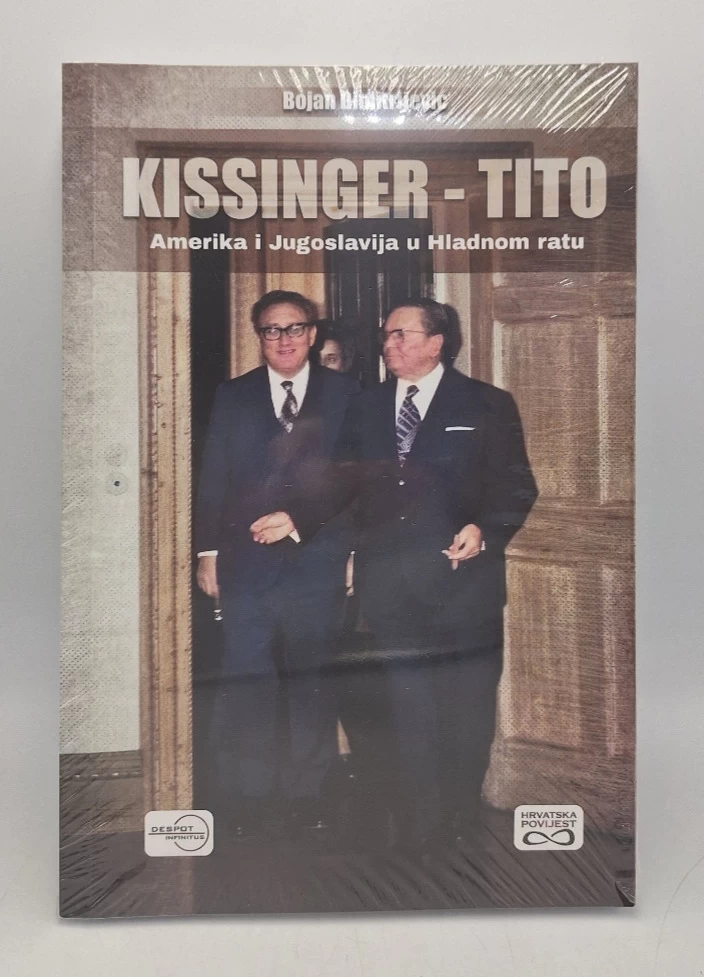
Kissinger - Tito: Amerika i Jugoslavija u hladnom ratu
Basic information
- Author: Dimitrijević Bojan
- Publisher: Despot Infinitus
- Availability: Available
- Condition: New book
- Code: 79940
Shipping options
Payment methods
Explore more
Kissinger - Tito: Amerika i Jugoslavija u hladnom ratu
Dimitrijević Bojan
Summary
Bojan Dimitrijević: Kissinger - Tito: America and Yugoslavia in the Cold War
Synonymous with American foreign policy in the Cold War era, Henry Kissinger met with the Yugoslav leader Josip Broz Tito on several occasions during the seventies - as many as six times, and he also had several meetings with other prominent figures of the Yugoslav state and diplomacy. Taking the post of President Nixon's assistant for national security in a period of great crisis in American foreign policy due to the difficult engagement in the conflict in Vietnam, Kissinger was greatly tempted to translate his previous intellectual experiences into real policy, which would be implemented by the American president. In his perception, socialist Yugoslavia had a special place as a country that opened a crack in the Eastern Communist bloc and served as a kind of example for other countries to eventually follow the path of "Titoism" - as he himself called Yugoslavia's policy of moving away from the Eastern, Communist bloc - but also as a strategic point of American policy to keep the Soviet Union out of access to the Mediterranean.
Kissinger had a rather constructive attitude towards Yugoslavia and its leader Tito. He was an intellectual of anti-communist orientation, which he did not hide, and he did not tolerate the activities of the Non-Aligned Movement, whose views he often clashed with in various parts of the world or in the United Nations Assembly. All this could have led to a bad mood towards the Yugoslav side, especially Tito. Frequent oscillations in Yugoslav foreign policy, critical tones towards the United States and support for revolutionary and radical movements throughout the so-called Third World are factors that only further irritated Kissinger. This is why - especially in his most influential phase - he had words of criticism for such attitudes and often left the Yugoslav Minister of Foreign Affairs Minic without an appointment for a meeting.
Nevertheless, Kissinger recognized the special importance of Yugoslavia and that is why he dealt with relations with it quite a lot.
Additional information
- Author: Dimitrijević Bojan
- Publisher: Despot Infinitus
- Year of publication:2023
- Place of publication:Zagreb
- Pages:236
- Dimensions:16x24 cm
- Script:Latin script
- Condition:New book
- Binding:Softcover
Reviews
0 reviewsWrite a review
Share your experience and help other readers choose.
This item has no reviews yet. Be the first to share your experience.
More books by Dimitrijević Bojan

More books from Despot Infinitus








You may also like