
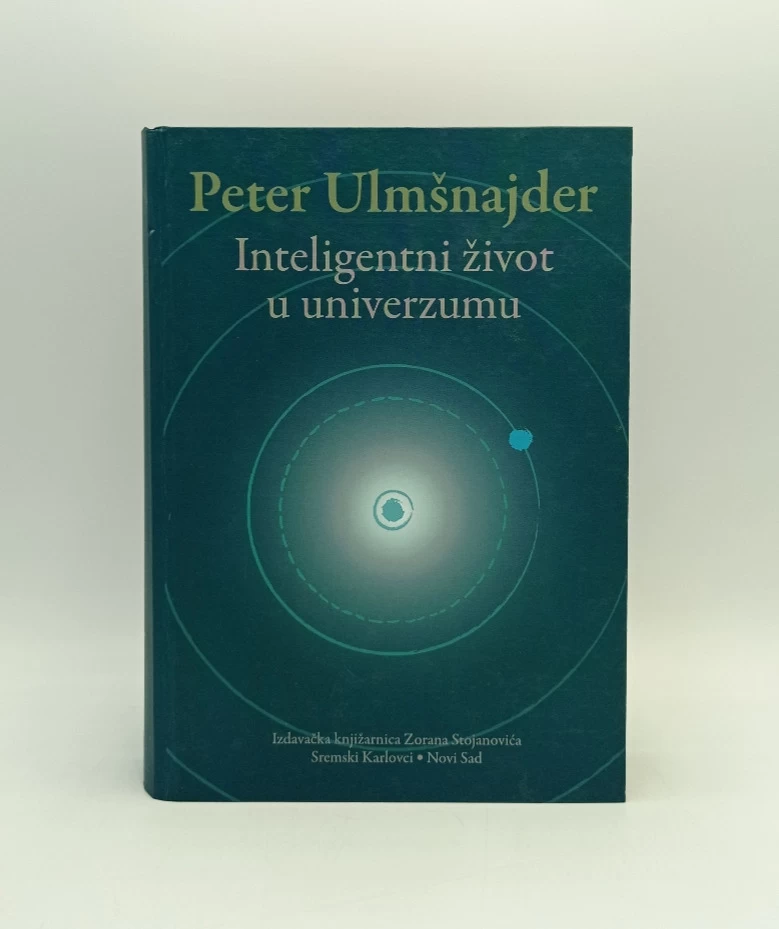
Inteligentni život u univerzumu
Basic information
- Author: Ulmschneider Peter
- Publisher: Izdavačka knjižarnica Zorana Stojanovića
- Availability: Available
- Condition: Excellent
- Code: 47036
Shipping options
Payment methods
Explore more
Inteligentni život u univerzumu
Ulmschneider Peter
Summary
Peter Ulmschneider: Intelligent Life in the Universe
With this approach, Intelligent Life in the Universe achieves two valuable goals. Primarily, it represents a kind of update of the classic book on this subject, the masterpiece of the great Russian astrophysicist Josif Samuilovich Šklovski, Vasion, život, razum (1962), or its English edition that appeared four years later, edited and supplemented by none other than Carl Sagan, a great personal friend and collaborator of Šklovski. The English edition has the same title (Intelligent Life in the Universe) as Ulmschneider's book, and even a cursory glance shows that the two books have a similar structure - one section each devoted predominantly to the astronomical background, prerequisites for biological evolution, and finally to SETI in the narrower sense. However, the sudden expansion of many areas touched by this extremely multidisciplinary topic in the period after the appearance of Šklovski's and Sagan's book means that the details of these two works differ drastically. While Šklovski and Sagan were forced to paint with a broad brush, Ulmschneider gives us a detailed cross-section of a broad subject for post-1995. period, where the very volume of material forces him to be extremely concise, leaving the details for the interested reader to see independently in the extensive bibliography. This huge difference between these two books shows us more clearly than anything else how much the scientific "landscape" has changed with the arrival of the astrobiological revolution.
Secondly, Ulmschneider's book emphasizes that the discussion of intelligent life outside the Earth and the search for it is inseparably and essentially linked to the entire astrobiological discourse, something that prima facie seems obvious, but which unfortunately is too often overlooked in professional publications on these topics. Through the unpredictable course of history and the Zeitgeist, we have come to a situation where SETI projects are no longer to that extent a harbinger and harbinger of the future, and especially what we could call a cosmic vision of the future of humanity. On the contrary, one can observe a certain atmosphere of cynicism with which these activities are surrounded - and not only by their declared opponents. Description of modern SETI projects, in section 10.6. it is given quite laconically, but strictly adequately - it is the practice, namely, that lags behind what we could expect, almost half a century after the first pioneering attempts at the search in the modern sense of the word. This is especially visible in the relation of practical SETI activities to classical skeptical arguments, the most significant of which is the Fermi paradox, which we will return to later. Ulmschneider emphasizes that overcoming these limitations is necessary, and that the SETI endeavor is an integral part of the astrobiological discourse, from which there can only be theoretical and practical benefits.
Additional information
- Author: Ulmschneider Peter
- Publisher: Izdavačka knjižarnica Zorana S...
- Year of publication:2011
- Place of publication:Novi Sad
- Pages:476
- Dimensions:15x21 cm
- Script:Latin script
- Condition:Excellent
- Binding:Hardcover
Reviews
0 reviewsWrite a review
Share your experience and help other readers choose.
This item has no reviews yet. Be the first to share your experience.
More books from Izdavačka knjižarnica Zorana Stojanovića