
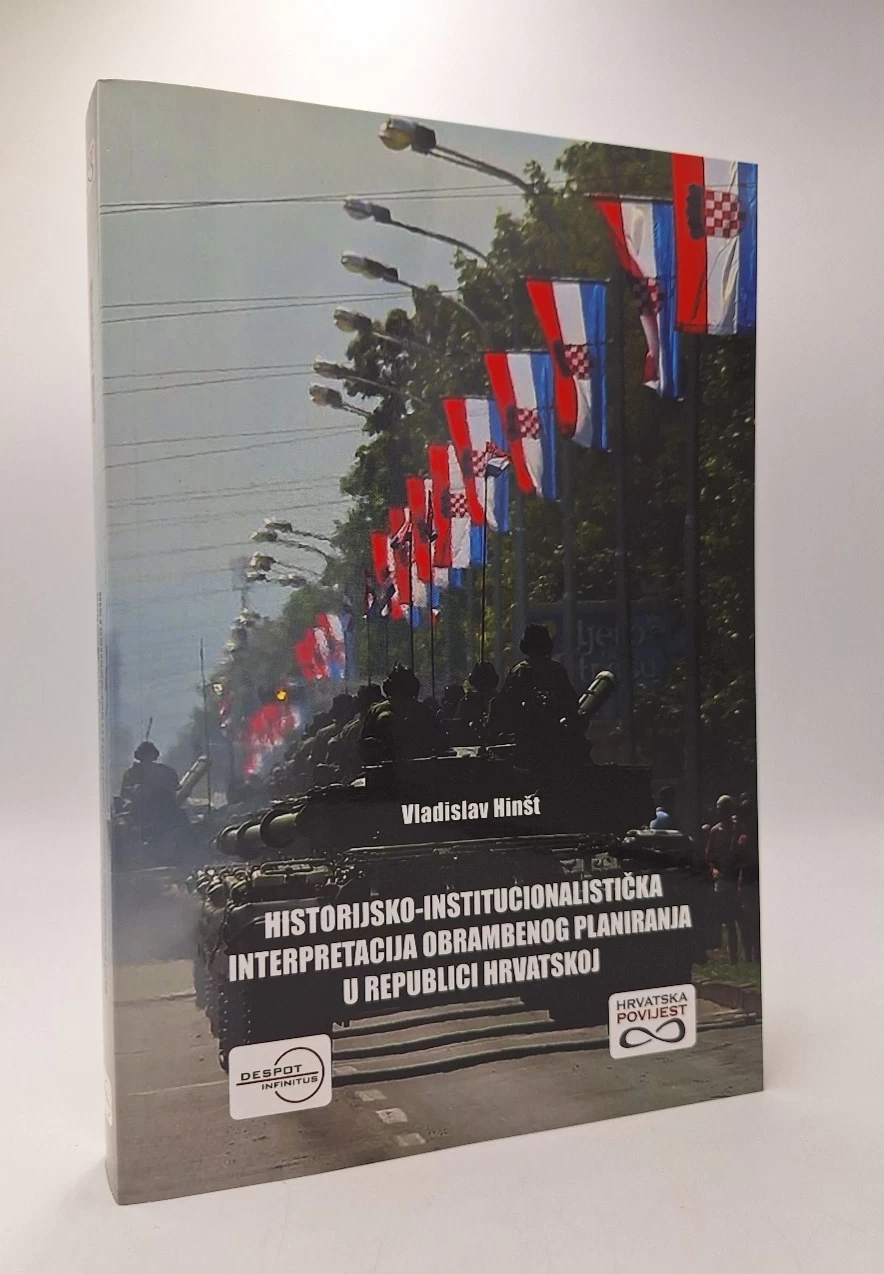
Historijsko-institucionalistička interpretacija obrambenog planiranja u Republici Hrvatskoj
Basic information
- Author: Hinšt Vladislav
- Publisher: Despot Infinitus
- Availability: Available
- Condition: Excellent
- Code: 72473
Shipping options
Payment methods
Explore more
Historijsko-institucionalistička interpretacija obrambenog planiranja u Republici Hrvatskoj
Hinšt Vladislav
Summary
Vladislav Hinšt: Historical-institutionalist interpretation of defense planning in the Republic of Croatia
The fundamental goal of the book is aimed at a systematized presentation of the origin and development of the modern approach to defense planning in the Republic of Croatia through the construct of five dimensions of public policies - temporal, institutional-organizational, contextual, economic-budgetary and political-institutional - in order to then conduct an institutionalist analysis. The research approach was developed within the theoretical-methodological framework of new institutionalism, i.e. its type - historical institutionalism, and as it is a phenomenon of the System of planning, programming, preparation and execution of budgets, whose features are the premises of neoclassical economics and economic rationality in general, key concepts of new institutional economics, which are necessary for researching the relative success of the System's application, are also introduced into the analysis. In the institutional analysis, the period from 1996 to 2007 was determined as the time frame of the research, which is divided into three sub-periods within which changes in formal and informal institutions can be differentiated. The research is based on the reconstruction of the origin and development of the modern approach to defense planning by determining the critical dividing lines and determining the dependence on the path traveled in relation to the early institutional choice of orientation towards NATO membership. A diachronic review of critical dividing lines was carried out by analyzing the content of defense policy and planning documents, and a broader contextual insight is the result of the observation method, and in some cases, the observation method with active participation. The use of the observation method also refers to the state and relations within the Croatian public administration as a whole. The fundamental finding of the research is: through early institutional choices in defense policy, the Republic of Croatia achieved the transparency of defense planning and budgeting and developed appropriate mechanisms of democratic control of the armed forces, thereby gradually fulfilling the prerequisites for joining NATO. The institutional development of defense planning directly influenced Croatia's approach to NATO. This created a dependence on the traveled path in defense planning.
Additional information
- Author: Hinšt Vladislav
- Publisher: Despot Infinitus
- Year of publication:2016
- Place of publication:Zagreb
- Pages:287
- Dimensions:16.5x24.5 cm
- Script:Latin script
- Condition:Excellent
- Binding:Softcover
Reviews
0 reviewsWrite a review
Share your experience and help other readers choose.
This item has no reviews yet. Be the first to share your experience.
More books from Despot Infinitus





You may also like